Showing posts with label Strategic Planning. Show all posts

Monday, December 29, 2014

Work Flow & Cash Flow

Not Too Long Ago In An Office Not Too Far Away….

Lean Guy and Money Girl worked around each other, listened to each other and other team managers talk about their current statuses and issues in the Monday 8am meeting every week, but did not really connect the dots between the results they were both trying to achieve individually.  Sure, everyone has gone through the Intro to Continuous Improvement training, the site was 99% compliant to that target.  And the site completes their mandated “3 Kaizens per Year” target easily by the end of the second quarter every year; we are number 1 in the company!


Sound familiar?  While these goals and targets are not bad, do you know why they exist and the purpose they serve?  We spend a considerable amount of time talking about activities that are value-added in a process, but how does this translate into increasing the value of the site or company?

Friday, July 11, 2014

Transparency

Part Four of the Foundation Thinking Series

The word Transparency has received much attention over the last few years, yet I believe it is misunderstood among those who use it most.  Transparency implies openness, communication, and accountability. Transparency is operating in such a way that it is easy for everyone to see what actions are performed and how decisions are made.  We can see the results of actual Transparency in our Behaviors, Performance, and Values.


And since companies can't actually be accountable, communicate, be open, or exhibit other human behaviors we are really talking about the people in the company.  The people in the organization must have the right behaviors, performance, values, and integrity.  Problems around those issues will not be repaired if they stay in the dark bureaucracy where "people" barriers stop the flow of information.  If people in your organization have integrity problems, you will not like the results of you new-found imperative.

Monday, June 9, 2014

Employee Buy-In to the Improvement Plan

As individuals we come up with really good ideas, changes to Products, Processes, and/or People in order to drive higher levels of Performance.  If we find a few people who think like us, the ideas and plans can become very elaborate.  We can hide in our offices or in the Innovation Stations and draw thought maps that would rival the great thinkers of Harvard and Yale.  But when we start implementing we fail to see the change we were looking for, our great ideas are stoned in the middle of the street, and we are ridiculed in front of our peers.

And that did not turn out how we thought it would.... once again.

Shaping the Vision

As we have explored before, change is hard.  It's harder when we don't include decision makers and smart people in the deployment of the vision.  The Captain of the ship points the way and we get to figure out how to get there.  "We" does not mean only the Directors and Senior Managers, it means all of us.  There are oodles of people out there, with skills and abilities that can help plan the change, execute the plan, transform the organization, and assess the results.

As the Captain's Executive Officer (XO), you get to figure out how to take the sometimes lofty statements by the boss and then translate them into what the future looks like for the organization and you are the point person for supporting the teams when the transformation begins.  More than likely you have something to start with, the Vision & Mission Statements, and the boss's lofty statements will typically track along in parallel.  Functionally this means something slightly different for each section of the organization based on how each connects to the main product or service that is provided.

The Correct Way To Draw An Org Chart

We have discussed creating the vision and specifying value in the past, but how do we take our thoughts and dreams on paper to those in the organization that will be going on this journey with us?  Spend some time talking with those teams to explore how they see themselves fitting into the Vision & Mission Statements and what do their metrics say about performance.  When they talk about the "things" they provide for the product or service, are they reflected on your VSM or Strategy Map?

Communicating the Vision

I'm going to presume that if you are in some sort (any sort) of Leadership position, that you have gotten over the fear of public speaking.  This will not be a one-time flash of the power point slide during an all-hands meeting and then you never speak of it again.  It will be discussed until everyone understands and are ready to start moving forward, and part of the conversation will be one where the vision is shaped.

You should discuss it everywhere you go.  Visit all the teams in their stand-up meetings, even if it's at 6am.  If you can put it on one piece of paper, hang the vision in the break rooms and the performance measurement screens on the walls.  Make it part of the company newsletters and create a video discussing the vision and how important it is to the organization.  When you are discussing it, do try to sound a little excited about the journey and the possibilities it will open for everyone.  And let the teams know they are part of this journey because they will be making adjustments to their 4P's also.

Share results with the organization while the transformation is ongoing.  What are the wins, what are the lessons learned, and what has been accomplished?  Reward some team members if you are having an all-hands meeting with the organization.  Instant awards like restaurant gift cards are cheap and easy.  Handwritten thank you notes provide a personal touch not seen today as often.  Award certifications if there are Green Belt or Black Belt certification projects tied to the change.

People want to know what you think about the transformation and if they are doing a good job.  Communication always comes up as a top issue for organizations and some of these ideas can help move you forward along your Lean Transformation.


Tuesday, June 3, 2014

Lean Roadmap


Roadmaps are handy little things, helping to point the direction while on a journey.  Sometimes they serve to identify markers on the road letting us know how far along we are, or telling us how far to go to the next marker.  The Lean Roadmap provides some general direction to keep our focus forward.  Many times we will not get the results that we want when we pick our favorite concept to launch into first. The steps in this map build upon each other to reach the smooth flow of the moving or pulse line.  Just like most other efforts we start by talking to our customers and finding out what they like, don't like, and what's important (what is value?).  We can make some presumptions about our customers, but we should go talk with them and confirm our beliefs.


Create the Vision

We all know that being able to describe the vision simply or on paper is one of the most important first steps in communicating the vision, and being able to imagine the potential in your organization's operations can put you on the road to good change.  Creating the vision may or may not be aligned with your organization's offerings, and the most important question to answer is "how are we creating value for the customer"?

When we measure Product of the 4P's (People, Process, Product, Performance) we are taking a look at the product performance and customer demand.  The measure of performance should be based on the requirements or the capabilities the product is sold upon.  Customers have expectations about the Product for how it performs today and future enhancements.  Does the vision need the Product to be enhanced?  This is one part of the Vision.  We must also evaluate how our Processes operate, do our People have the skills and abilities for new Products and Processes, and is the Performance good enough to provide the customer the experience that will keep them coming back for more?

Standardize the Flow From Improvements

Once we know where we are going (Future Vision) we need to know where we are starting (Current State) and where is the first marker (Future State).  These are high-level maps and metrics describing the Vision and different States.  These will be used to target improvements in the flows: product flows, work flows, and cash flows.  

Target and reduce the waste and variation.  This is the mantra, this is the drumbeat.  Everything follows a rhythm and this moves the organization to the next level of performance.  Learn from your processes and make changes that can be documented in your SOP's, Policy Statements, and other Work Documentation.  Deploy the new learning across the organization and manage the change reaching higher levels of performance.  Using a Kaizen approach will be faster, and small steps will be required.

Make the Supplies and Information Point-Of-Use

Improving the flows is not only the transformation steps in process, but creating efficient movement of inputs to the process.  Make the material and information inputs easy to find and fast to move.  Ensure this is documented in the new process and that everyone is emotionally and physically on board with the new way.  Implementing 5S concepts in your operations are focused on organizing and not housekeeping.  Organize your material and information in files and on your servers/clients.

Balance the Team

As you make improvement stay aware of bottlenecks in the system.  Comparing cycle time to takt time will assist in determining where the help is needed first.  Continue this analysis as customer demand changes.  Bottlenecks can (and will) move through your system.


Implement Visual Controls and Response

Visual Controls are the metrics, schedule, and constraints posted on the wall or on the displays that the team needs to be aware of.  While we may have the vision that says "no more fire-fighting", there should be some recognition that quick action is sometimes needed.  Having the signals in place that facilitates this planned response is much better than waiting for the boss to find out from an unhappy customer.  This type of system is the foundation of an Employee Empowered Workforce.

Connect Suppliers Using Pull System

Implementing a Pull System is much more difficult and will create much frustration if you have not started improving your flow.  Responding only when the order is received (start signal) should keep cash flow high by not spending those dollars on material and labor that will only increase Work-In-Process (WIP).  High levels of WIP in your system is just half-built product sitting around waiting to be damaged or made obsolete.

Move/Pulse the Line

We can all envision a Moving Line with Lucy and Ethel inspecting and packaging chocolates.  A Pulse Line is one with products that move to the takt time and they have longer cycle times or the cost to automate the transfer is too high.  In the places where our office products are created, we can use electronic workflow queuing to move products and to status completion.  The "Line" is really a collection of interdependent work teams operating to accomplish a series of tasks.  The results are fed back into the Visual Controls and then analyzed for new learning.  Using this method will help us to move to higher and more stable levels of performance.


I hope this encourages you to take another look at Lean Flow and how you may use the tools and techniques to improvement customer satisfaction and employee relationships.


Monday, September 24, 2012

Can Lean and Corporate Governance Play Together?

We’re going to go deep behind Executive Lines this week so don’t get left behind.  There is quite a bit of regulation out there telling companies how to act, walk, talk, eat, etc, etc, and if you want to raise some capital by selling shares of you company on the market you will have much more to deal with.  I will not be providing any opinions on the Sarbanes-Oxley Act, but over the last 30 years Corporate Governance has received plenty of attention especially after Enron, Worldcom, and other situations.

What is corporate governance?

Let’s start with a definition on Corporate Governance.  Simply, it is the system by which companies are directed and controlled, (Wikipedia, SEP 2012).   It attempts to define the interactions between Board of Director members, management, and shareholders.   You could add stakeholders to this list also based on the amount of airplay companies receive.  But let’s focus on the basic definition words “system”, and “directed and controlled”.

Much of this addresses the communication path through management, the board, and shareholders.  We can see this in the shareholder reports, and on financial websites with the company’s balance sheet, income statement, and statement of cash flow.  Inside the company the communication the board and management uses should be  a little more action oriented.  When I say communication, I mean the metrics.

How good is the company’s delivery? 
Oh, it’s good. 
How good? 
Real good.

Sound familiar in the office area?  Does anyone really know?  When the strategic plan is built, there should be some recognition of measurable performance goals.  If you don’t know, go ask your customer what is important about the delivery of your product.  Oh, it needs to be good.  How good?  Real good.

What is a Lean System?

Let’s go back to this system.  When we talk about a Lean System, we are talking about making our office products at the rate or pull of customer demand.  Do we have this thinking in our systems?  Yes, that does mean to put Just-In-Time methods in our order systems.  Remember, JIT is not just about reducing inventory costs, it puts a glaring spotlight on the problem areas.  The same areas where we improve the flow of our information products.

Align the Lean System with the Strategic plan and we begin to provide actionable metrics going to the board and management, and in the right hands of a visionary Leader this can produce transformation that strengthens the company and produces happy customer.  How happy?  Real happy!

The measures going to management should show how we are affecting the results.  These could show that performance is better, worse, or remained the same.  If the results have not changed, then the team has not found the root causes, or the improvements are not working and we will hold off the pizza party until we have sustained positive results.

Can we institutionalize continuous improvement?

Improvement can be institutionalized by creating the expectation, and required metrics to review, and growing the people who show aptitude for Leadership out of the ranks of Green Belts and Black belts.  I did not say that all Leaders should be belts, but there is a good place to look.  Leaders should have their performance measured and Executives do not have a “come-apart” the first time a chart is Red or Yellow.  These are indicators of process performance issues that need to be addressed.

ISO and CMMI provide frameworks of systems, but these are dependent on people working within the boundaries and keeping the documentation current.  Companies and teams still develop their own methods and processes and these should be measured and reported upon.  If you are not going to manage the process, then don’t measure it.  And don’t be surprised if you do not receive the performance you think that you are entitled to receive.

As we go through this journey, we should be using road signs and maps to help us see where we are.  Working with Leadership and our employees will strengthen the relationships and improve morale.  Doing the right things at the right time should result in satisfied customers.

Have you seen a successful transition of practices when Leadership has changed hands?

Monday, September 17, 2012

Future State Value Stream Mapping

Standing in the office, staring at the wall with your Current State Value Stream Map (VSM) pinned up, you may be thinking that someone needs to hide this thing before the boss walks in.  The communication lines look like one of those sketti-maps, and the work balance chart is normally distributed.  Take a breath and remember that this is a journey, don't stop believin'.

Remember the Normal Distribution?

Time for some calm and rational thinking, what did the Lean Policy Deployment matrix indicate that was the highest priority for the team?  You can see the operational targets and how they relate to what is important, but what does this mean for our processes?  Now we are connecting the dots between where we are now and where we need to be moving toward.  Do we have the measurements in place to help us see where we are?  If not there needs to be a line drawn in the sand for our baseline or starting point.

Take the goals from the Lean Policy Deployment matrix and any yearly "goals & objectives" given to the team, and connect them to your Current State VSM.  What picture emerges?  Does this flatten your work balance chart?  If you find that your goals do not change your VSM, you may have weak or ineffective goals.

Now is the chance to talk with the team.  Get their opinion on the obvious problems pointed out on the map.  What problems do they see on a recurring basis?  What opportunities do they see?  This is a great way to empower and engage the team.  They want to be listened to, they want to know that their input is valuable and that they are not just button pushers making documents go somewhere.
Our VSM friend, the Starburst!

Armed with this data, you have something to talk about with the boss.  Show them where you think the problems exists, show the data, and then show them the starbursts that you and the team created.  Give some credit for the creativity of the team!  Talk about where you think you could improve performance and customer satisfaction.  The boss may provide some more goals to think about for transforming to a Lean flow.

Take the starbursts and place them on a Benefit/Effort matrix and now you and the boss have something to work with to prioritize the improvement activities for the coming year.  Below could be your new best friend for prioritizing opportunities, the PICK Chart.  Decisions made from this matrix will need to be balanced against the Lean Policy Deployment matrix.  Think about what is important to improve and what is attainable. 
PICK Chart
If this is your first time to attempt to formally improve your processes, take the top one or two prioritized opportunities and compare their goals to the Current State Value Stream Map.  What impact will these make to the 4P's or to Safety, Quality, Cost, and Delivery?  These opportunities may enable other improvements, like communication flow or decision making processes.  Don't let the fear of making Quality improvements impact what is executed first.

Now we bring in our tried and true project management skills and abilities.  Write a problem statement without any assumption of root causes, define SMART goals, and determine deliverables.  Document the project on a one-page A3, there is no need for a 125 slide project briefing.  There is nothing brief about 125 slides, seriously, knock it off!  Put the smart people in a room, find the "Belt" person you have heard about and start exploring what is going on with the process.

Share what you have learned with the work team as you go through the project determining root causes and deciding what your going to do about it.  Create some metrics and a desk guide to keep you from backsliding to the old, comfortable, chaotic process.  You are responsible for the team's results, own it!  When the process is fixed, celebrate the success with the team.

In 12 months you're going to go through this again.  Make sure you have your stuff in order.

Is change hard?  Yes, but so is coming into work everyday knowing that poor performance is making an impact to the team's moral and no one cares to make it better.

Have you seen VSM be successfully used as a strategic planning tool or ever been involved in a VSM "Event"?

Monday, September 3, 2012

Lean Policy Deployment

Aligning tactics to strategy

Welcome to September!  Guess what it is time for now?  That's right, this year's goals and objectives for the company.  How are we doing this year so far?  Did you set sales, safety, delivery, or financial goals?  Did you build that new capability you wanted?  Are your teams progressing in maturity?

These are worthy and usual safe things to chase, but are they the right things for your company or teams?  You will also find that you may have a team or site that is the benchmark for the company.  Translating your vision into the strategy is up to you and your board of directors, and determining how to advance to that vision will be executed by management and the teams.  Each team member is aware of their strengths and weaknesses, and this tool can help them grow into that type of person they want to be.


How to build
  1. Identify the key issues in the organization's customer focused performance.  These may come from a Value Stream Mapping Event or a strategic offsite meeting.
  2. Determine measurable business objectives that address these performance issues.  You are not boiling the ocean, and they do not say "do stuff better".  A good tool to use here would be a Balanced Scorecard.
  3. Define or Refine the overall vision and goals.  Goals will be listed under Target Operational Results.
  4. Develop supporting strategies for pursuing the goals.  These will be listed next to the Objectives.
  5. Determine the tactics (or projects) and targets that facilitate each strategy.  List tactics above Selected Projects and targets next to Improvement Targets.  
  6. Decide the strength of alignment within the matrixed entries on the map.
  7. Implement performance measures for every business process.  If it is worth doing, it is worth measuring and doing right.  Yes measuring is hard, but so is laying people off because you did not work on the things that were important.
  8. Measure business processes during execution.  Do not wait until the end of the year to see if you hit any targets.

How to measure

And now we are off and running!  We are delivering sales orders, reports, and briefings.  The team is collecting data and we are compiling it into something that tells the real story.  Whether we are using a fully automated workflow tool with performance reporting, or collecting information on a form and typing it in a spreadsheet, we need to make sure we share it with the team.

Don't try to create excuses if the information is not great, we are smart enough to see through management's smoke screens.  This is the perfect opportunity to use some A3 Problem Solving.  Use the results to strengthen your system and processes, and celebrate your successes once in a while.


What results have you seen with your improvement planning?

Monday, August 13, 2012

Change Fundamentals

“Change makes me feel uncomfortable.”
“Change is hard.”
“We don’t need to change, everything is fine.”

I’m sure you have heard these before, maybe even said something like this.  But now you are in a position of Leadership or you are responsible for the activities of a team and you see that you’re not reaching the performance levels you need to get ahead.  Money Girl may be scheduling meetings with you twice a week to discuss your budget numbers.  You could be meeting twice a day and that is not going to solve your problems.


This model is used help align groups of people to specific results and keep them within the left and right boundaries of their tasks and responsibilities.  The Beliefs of the individuals on the teams will lead to the Behaviors which drive their Actions that produce Results.  This helps to show why people think “Change is hard” and you do not see the Results.  Turning the team around is not only your responsibility; it’s in your skills toolbox.

The first step is the hardest because the team’s lack of momentum has anchored them to the past.  Did they win a team performance or safety award ten years ago?  Does your team currently perform the best in the branch but their internal competitors should all be sent back to the farm team?  You may find the team is the “cream of the crap” and this is never a nice realization.

You need to find out what the team Believes.  Do they really know their performance or want to know?  Do they believe they have the ability or permission to make change?  Do the team members have the skills, knowledge, and ability to perform the work that is being asked of them?  And there are more questions you could ask based on your industry or location.

Beliefs are the hardest to change; many were shaped by past experiences.  You will be battling against previous good or bad managers, corporate cultures, left-wing professors, and perhaps an undesirable work ethic.  Some team members will be easy to shift and a small number, if any, will probably need to be released back to wild.  Jim Collins talked about having people in the right seats on the bus, assuming they are on the right bus to begin with.

Tools to help Leaders re-align the individual’s and team’s Behaviors are the Company’s Vision, Mission, Goals and Objectives.  Do your team members know how and where they fit in the Vision and Mission?  This may take some exploration with the team and your Leadership.  I have seen teams try to determine how they fit, review this with Leadership and are sent back being told to try again.  This is not a catastrophic event as long as you can show you are learning from the experience.

Goals and Objectives play a large part by providing a basis for measuring the team.  Remember that not every team will have Objectives for every Goal, and try not to overthink your importance to the site but be open to how everyone fits together.  Goals should link Objectives to the Vision and Mission.

Measuring the team’s current performance to the Goals and Objectives can be an enlightening event that will drive the team to Action.  Don’t just print the chart and stick it on the wall, share it with the team and ask questions that lead to sustained high performance.  Using A3 Thinking helps to document what the team is experiencing and how they can learn by evaluating the low and high performance times.  This learning is documented in the team’s standard work, SOP, or Desk Guide and is used for training new team members.

These Actions will create Results with increased performance, higher levels of predictability, and increased team moral.  We are not just robots moving paper from one pile to another pile; we are thinking creatures with drive and a desire to make customers happy with the products we provide.  The processes we work in will not improve on their own, they require the ingenuity and creativity we have in all of us to make change.  It is there, just waiting to flourish.

How have you seen or experienced a change in hearts and minds?

Monday, May 28, 2012

Lean Thinking - Specify Value

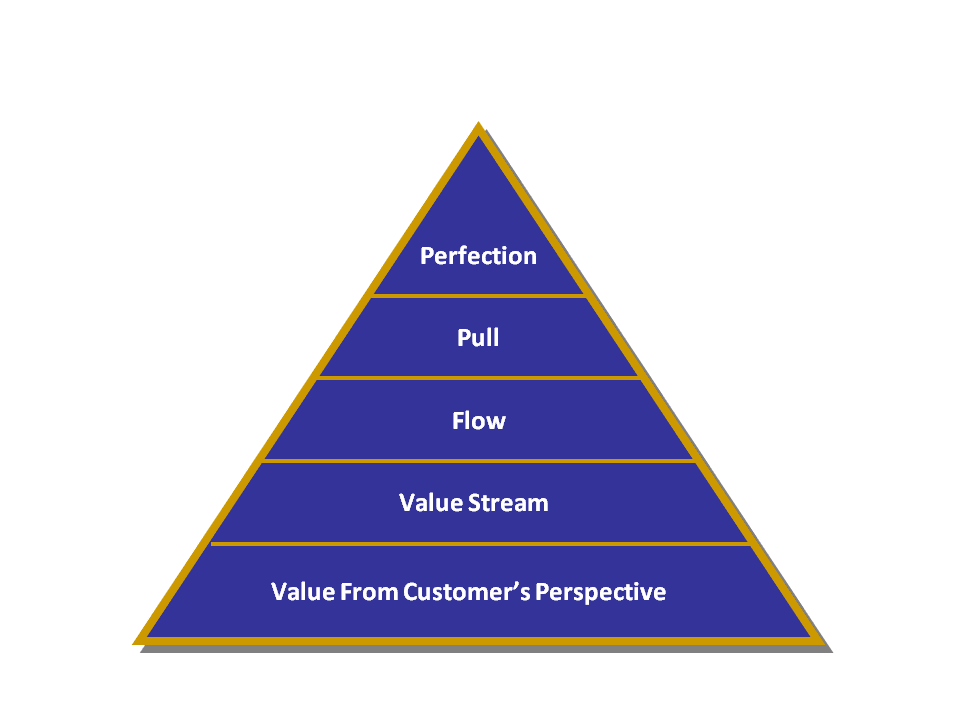
The next few entries will share some examples of Lean Thinking in the Office and we will begin the journey with the first of five steps.  Begin Lean Office transformation with strategically aligning the opportunities.


Step 1. Specify value from the standpoint of the end customer by product family.


Beginning the Lean Office transformation is not a decision to be made flippantly and without a plan.  Does this mean you need to be in crisis mode or your platform needs to be on fire?  It's not required, but it does help to put energy behind and a reason for the change.  You may find that a new material is available on the market at a price that improves profitability, or Congress has written new industry regulations, or perhaps a company that you thought had no chance in being a real competitor has just had a successful launch of a new product or service.  What ever the reason, it is now in your lap.

To start this journey we first have to decide what product needs help the most.  Is it a series of financial reports, or briefings to provide information to decision makers, or how we procure office equipment?  One thing you cannot say is, "Lets go fix the sales team!!".  This is focused on the products we create, not people to berate.

Here we come to fix the Sales Team!!


The next step is to go have a conversation with your customer about the chosen product.  Now this should not be a scary trip to take.  When you schedule this discussion, frame it be asking some questions up front like "what about the delivery of my product needs to be perfect?".  Use this to collect attributes that would be critical to the quality of your product.

Another side of this method is asking what are the business needs of your operations.  Do you have to operate within a budget, or maintain a skills or knowledge requirement, or keep a safe work environment?  Think about the measures you are keeping now and are they helping you and your team find opportunities?  This is also a great chance to go talk to your boss about their expectations of your team since it is your job to make the boss look good.

The third piece of the puzzle is how the process is performing.  Are you having visions of SPC charts right now?  My friend's wife would yell out "NERD ALERT!!" at this point and we would all quickly look busy.  We should know what is going on, but the measures we take need to be used for good and not evil.  We never, ever take a chart and go beat up our supplier of data even if that was the standard practice in your industry.

This first step is very important as it sets the foundation for the rest of the things you will see and learn with this product and your team as it helps to create the vision of what the future looks like, but this is not a "one and done" activity.  As the market changes, you may need to do this with your customers on a regular basis.  It requires courage and tenacity, and don't be afraid to ask for help!  You may learn that you have some other Lean Thinkers on your team to help along the way and you will need their help when you move to the next step of transformation.

Friday, May 11, 2012

Operational Excellence

When we think about linking people with the processes, products, and performance, using a model helps us see at a high level.  This also helps to create a system framework that connects tools and thinking to standard practices we will use.  Operational Excellence is a concept of operations that focuses a team's outputs on consistently meeting customer's needs and improving supply chain relationships.  I will address Operational Excellence implementation, the integration of tools with Integrated Teams, and ways to monitor success that will help you retain your customer base and open doors to new customers.

Implementation is aligned to a team's continuous performance improvement level.  Teams that are actively using Lean, Six Sigma, Theory of Constraints, or other improvement methodologies will implement faster than those that only know they have problems and are not sure how to permanently fix them.  It's the recognition that problems exist, or the journey is stalled, and that is where we begin by talking to the customer, asking what would be perfect about the delivery of the product, and measuring performance results to those attributes.  This may not be an easy conversation, but it provides insight to the level of satisfaction your customers are experiencing.  Using this information, Leadership needs to be armed with the questions that keep a project or team on track to reach that level of perfection.


Integration of tools with the Integrated Teams, focused on specific problems, will affect the measures being taken from the Voice of the Customer.  Whatever improvement tools or methodologies are being used, the desired impact is to improve flow.  This is made by using Lean to remove waste, Six Sigma to remove variation and improve quality, TOC to synchronize the supply chain with the bottle neck and then remove the constraint, or any combination of those with the plethora of other tools that exist.  Remember this, "Flow is King!".  If the product if not flowing, whether in the material value stream or information value stream, then it is sleeping (on the job!).

Monitoring the organization's or team's progress on the journey is enhanced with visual controls linked with the Voice of the Customer and the Voice of the Business.  We collected VOC earlier so it's just a matter of calculating the center and spread of the data, compare that to "what would be perfect", and decide the first step to take.  Voice of the Business is based on corporate or business unit goals, or goals used by the team.  These are usually related to cost, safety, inventory-turnover, and other measurements relating to cash flow.  Again, collect you current data, compare it to the goal, and decide the first step to take.  This resulting information needs to be shared with the team, stakeholders, customers, and possibly suppliers.

As you collect the data and begin asking questions as to why the team is experiencing defects, long cycle time, customer dis-satisfaction, or other problems, you will identify opportunities to make positive impacts to flow.  These opportunities will need to be vetted against the root causes to make sure they will affect the bottom line, not just "good stuff" types of ideas.  One way to know if an idea will impact the bottom line is if it resides on the critical path.  Newly trained improvement facilitators can execute these opportunities to become "certified".  Becoming certified is another measurement, the next important metric is average cycle time for the facilitators reach their fifth project.

So Operational Excellence is a concept of operations that focuses a team's outputs on consistently meeting customer's needs and improving supply chain relationships.  This type of thinking about your operations and your organization will help jump start the transformation and turn opportunities into the dollars that can be used to grow your business.