Showing posts with label Current State. Show all posts

Tuesday, September 24, 2013

Process Entitlement

We are all entitled to something, aren't we?  How about some peace and time to think before the fire-fighting begins?  Probably not.  That is unless we have thoughtfully designed our processes to perform at a specific level.  Short cycle time, high quality, just a few people touching the product, and we do not leave the day with a backlog larger than we can emotionally handle.  How often does this happen in your operations?

Profitable and Customer Satisfying processes do not happen accidentally or magically appear just because someone has the specials letters on their resume (MBA, MBB, SSBB, CQE, PMP, ETC).  These processes also do not "just work" because the right people are in the right place at the right time (Process Heroes).  It does not matter if we are using manufacturing or business processes, we should be able to receive predictable and profitable performance no matter which well trained and qualified person is sitting in that chair at that time.

Our Process Hero Saves the Day!
When you start measuring your processes you will probably find that the performance is not what you expected and you will have that sinking sensation.  Stop and breathe, this is normal to feel some level of anxiety once you have swallowed the red pill and it will pass as soon as you start to think about how to begin analyzing for root causes and implement solutions to address those root causes. So logically, if your process just happens because you throw a contract or database at the team then you will have the performance (good or bad) that just happens by chance.  If you have your Process Heroes in place you may have decent on time delivery or quality with rework and inspection, but performance will not be predictable.

Our Process Heroes can only go for so long, and remember what Dr. Tyrell told us, "The light that burns twice as bright can only burn for half as long" (Yes!  It's that important!).  When we burn out our Process Heroes we have to rely on people to inspect quality into our products, and Dr. Deming had something important to say about that too.

This change begins like most others, measure the results of the things going though your system.  This could be airplanes, circuit boards, decisions, grades, reports, or sales of widgets.  Are you receiving the results of your process that you are Entitled to receive?


Monday, November 19, 2012

We Just Lost Half of the Team

One day were are a happy team, plenty of work coming in and we don't have too many customers calling every other day about their orders.  Then the boss from corporate comes in, goes to our branch manager's office and closes the door.  This does not look good.

A couple of the sales guys split, muttering something about hand delivering some reports.  A few of us go to lunch and the rest plan out the remainder of the day.  The manager's office is empty when we return, but our in-boxes have a meeting notice at the end of the day.  Of course we all panic, there was nothing in the body of the email and we never have cake at the end of the day.

The remaining minutes and hours count down and we all meet in the larger conference room.  The branch manager is standing at the front of the room with a powerpoint on the wall.  He goes through the charts; sales per employee, backorders by customers, quality surveys from customers, accounts past due to suppliers.  None of this looks good and our question was how long had it been like this?  Has anyone been paying attention?

One by one we were called into the office.  There were three of us at the table, the branch manager, someone from corporate HR, and I.  They asked if I understood the information presented and I said that I did, and I asked how long has performance been like this?  He made some comments about the softness of the local economy and expected it to turn around at any time.  None of what he said sounded good.

About half the team survived this round of layoffs.  We had to do something.....

This is how some organizations start their Lean Journey.  Sometimes we see teams respond with positive change by using their metrics and creating a plan to improve customer satisfaction and aggressively getting new orders and customers.  Sometimes the teams blame others, lobby for a government bail-out, and continue in their same, old, wasteful ways.

Just like any other personally damaging situations; smoking, obesity, and high-stress are all responses to bad practices and our businesses can exhibit the same types of response factors.  Fire-fighting, low customer satisfaction, and poor team relationships are not going to fix themselves.  You can't wait for the team to turn around on their own.  Someone (you) needs to make a bold statement.  "We will no longer be in the Fire-Fighting business!"

You will hear some chuckles, but it's ok.  Half of the team is gone, so how do you do the same amount of work with less people?  It's not simple, but you're going to have to learn from your mistakes.  Talk to your customers about your delivery, look at how you do things and improve.  You have to get the team out of Egypt and get Egypt out of the team.

You  may be tempted to start creating plans and roadmaps and start bringing in high-powered consultants.  If you were starting the Lean Journey when times were good, those tools would be perfect, but you are not and we need to start the transformation now.  Your Burning Platform (or BHAG) is right in front of you, take a picture if you need one.  Start with the processes you use to create your products and remember this analysis is based on the thing going through the system or process.  Do you have any performance data; cost, quality, delivery?  If not, then begin collecting it now.

Have you talked to your customers yet?  We will use that information when we create the new processes.  We may even pull out our House of Quality (or QFD) to help align customer needs and the requirements we must comply with.

We then map those processes and remember this is based on how we do it now, not how we want to or what the SOP says how the process is supposed to operate.  Ask where are those inspection review processes and how we fix the documents?  Circle these steps with a Red Sharpie, these will be targeted first!  If you have some sort of review trail from emails or a workflow system, put the quality failures in categories and force rank them by count so you can attack the worst offenders first.

Once you have that, get the team together for a fishbone party.  Remember that you put the problem statement or quality failure at the head of the fish and the potential causes on the four bones.  What four bones?  I'm glad you asked.

If you start using Man, Method, Measurement, Mother Nature, Material, and Machine in the office you will spend the next hours trying to get the team to not think of these in manufacturing terms.  In our information processes we use People, Place, Policy, and Procedures.  Nearly all issues that exist today will fall into those categories.  When the team is passed out on the floor and have nothing else to give, begin weeding out the least likely causes and work your way up to the most likely or direct causes.

Bundle related causes together and begin brainstorming potential solutions.  We will also begin to start mapping out the new process based on the number people available, a "No Fire-Fighting" culture, a bold statement that our internal teams will neither accept or pass on defective information, and we cannot inspect quality into our products as high-quality must come from the process.  Everyone must buy-in to the new process, both the smart people doing the jobs and the Leaders of the organizations.

Once you have tried a few things and have picked the best of the best (for now) you need to document how the process operates so when new team members come on when the economy recovers they have something to be trained on.  Determine some metrics so poor performance is not a surprise anymore and there will be plenty of time to respond.  Everyone needs to know what right looks like.

Transforming under fire is never pleasant, but the good times just doesn't always provide the need for change.  Bad things happen, and then we pick up the pieces and continue on.

When your team has been through a rough time, what kind of lasting change did you make?

Tuesday, October 16, 2012

Bi-Polar Working Environment

Looking back on it, the highs were high and the lows were low.  Does work seem like an endless roller coaster?  Do you run from one fire to another, double-booked status meetings, or was that another failed review with the originator pulling out of the parking lot for the weekend?  You think you get off the ride at the end of the day when you leave the gate, or is that just the part of the ride that is not doing loops?

What is in your mind when hear "a steady flow of work"?  A gently flowing stream that pops with trout hitting the surface and the water is bubbling through the rocks?  No, that is supposed to be a vacation.  Did I just hear someone's cell phone buzz while we are fly-fishing?


How many of us walk in to the build and put on our fire fighting gear?  Go ahead and put your hands down, I'm not taking a survey.  Our never taking off the gear is an indication that we do not have a workflow control system.  Everything is hot and/or late.

Getting out this mode of operation requires everyone on the team, including the coach, is making a conscience decision to stop treating everything as a fire.  And we have to start learning from our mistakes.  The solutions that support the learning must also be appropriately applied.  Anchoring the entire organization because of ethical or technical issues does not help foster trust between management and employees.

Operational Excellence is about the journey, not the destination.  We learn and grow while building trust through relationships.  You may not see it at first, but when you realize the roller coaster is no longer running you can see organizations are made up of people, not systems and tasks.

Monday, October 8, 2012

I Smell Soap!

How many times have we heard the warnings?
"Our biggest customer is coming (or the boss, or some shareholders, or OSHA) and we need to clean this place up!"

So we have two days to "clean this place up!"  Lucky for us we have a few well trained firefighters that can work and hide stacks of files, miscellaneous inventory, and review those customer reports so we can ship them out early tomorrow morning.  Everything else comes to a screeching halt.  Did I just hear one of the supervisors whisper that this looks like a 5S Blitz?

The big day arrives, everyone looks busy, the boss looks at the Ops Manager and says, "I smell soap!"

Or...

The big day arrives, everyone is busy, catching up on two days of downtime, when our favorite customer arrives.  "All of your office areas smell so clean!"  

She is getting the 5-Star treatment.  Walking through the areas, seeing a white board with tracking numbers next to the reports they ordered with status of "Delivered" next to them.  The Office's Operations Manager is smiling, and gives the customer a box of branded office swag, cups, banner pens, and flash drives, on her way out the door.

LOVE the banner pens!!


For those of you who honestly think this is what a rapid 5S Event looks like or that 5S is Housekeeping, I have a little secret for you.  You are wrong, not mistaken, and those who told you that were wrong.  For the rest of us this is turns into an effort in futility and the clutter will return in about two weeks.

There is a way to avoid all the dramatics, and fire-fighting.  The site has to become organized.  This is not something that a small group can accomplish, it's going to take everyone from the employees all the way up to the Leadership team.

5S is a system of organization that helps us answer the following questions:
Sort - Do we need everything we have?
Set in Order - Do we have everything we need?
Shine - Can we see abnormalities?
Standardize - Can anyone do this repeatedly?
Sustain - Are we maintaining or backsliding?

Each "S" is built on the previous, and it starts by Sorting to remove the fog of clutter.  If you see half eaten bags of cheesy poofs laying around, listen to the voices in your head and throw them away.  When we Set in Order we are removing searching waste.  We are no long a hunting and gathering society, work should be the same.  The work of Sorting and Setting in Order is executed by the smart people.  The actual people doing the actual work knows what is needed or not needed.  The boss can come participate, but only as a set of hands doing work.

When we Shine we are keeping our machines (printers, computers, network drives, etc) in a like new condition so we can see a small problem before it becomes a much larger problem.  How often does the printer go down because you ran out of paper in the office or because little hang-ups turned into an issue where we have to call the guy who sold us the printer four months ago?

When we Standardize we are documenting how we do things.  Is there a standard method to creating folders on the servers for new projects?  How about projects that are complete or abandoned?  How long does it take someone to find the information they are looking for?

Sustaining the gains involves Leadership being active in the change process and I don't mean they only move their furniture around.  Take a waste walk, go to the gemba!  That is the actual place where the actual people are doing the actual work.  Does the work flow?

One of these days the customer, or the boss, or OSHA is going to stop by unannounced...

Don't just shake your head up and down, share what you have seen in the comment box.

Monday, October 1, 2012

Teaching With Simulations

One of the joys of being the Lean Guy in the office is I get to share my knowledge and experience with other people writing contract documentation, purchasing orders, engineering changes, software code, system specs, and all the other pieces of information floating around the office.  When we talk about Lean and the thing they are working on it is helpful to show an example of what right looks like.  This is helpful because their product is special, and no one else processes it like they do.  Special....right.

We will presume that I am not dealing with a TQM victim that is feeling frisky that day.

A tool that I keep handy is the paper flow simulation.  We use index cards as the "document", technical reviewers, value-adders transforming the document, and some metrics for quality, cycle time, and throughput.  This sim is cheap, easy, portable, gets the point across, and I'm not going to give away the ending, but all the team win.

Another great teaching aid is the 5S Numbers Game.  I'm not sure who developed this, but it is my favorite for teaching 5S in the information flow.  This link will take you to Lean Simulations' 5S Numbers Game page where you can download it and try it out for yourself.

My Favorite Sim in the Office!
There are other longer Lean System simulations, The Beer Game at The Lean Learning Center, and a  simulation used by the U.S. Military called FedSim.  These teach supply chain control, aligning tasks with requirements, and passing products through the enterprise.

Videos are great too!  Terry Tate, The Bridge of Death with the Old Man from Scene 24, Dinosaur Office, Building Planes in the Air, and others help to lighten the mood and show how far into the extreme a process could go.


When thinking about sims and videos, make sure the topic fits the organization.  Factory sims, stories, or videos will not work in the office.  First reason is because few of the people you are talking to have ever seen a factory, much less stepped in one.  Second is because factories are loaded with assets; equipment, inventory, tools, things being transformed into a product being sold to someone.  And our processes have computers, printers, fax machines that no one uses anymore, binders, paper cutters, IT Helpdesks; yeah, we're special.

What kind of sims do you use in the office flow?

Monday, September 10, 2012

Current State Value Stream Mapping

Transformation has many requirements, two of those are knowing where we are and where we are going.  This week we will address how to see where we are using Rother and Shook's "Learning to See" method of Value Stream Mapping.  If you want to learn more about your process, this is a perfect way to do it. 

First the rules (oh, no!  not more rules), Value Stream Maps are based on products.  Don't get hung up on thinking about factories, we all make something.  Gears, cars, hot dogs, lawn chairs, pizzas, newspapers, lumber, stock analysis, laptops, contract statements of work, testing instructions, decisions what to spend resources upon, etc, etc, etc; get it?  We all produce something that is passed on to the next internal customer or our final external customer.

Our Current State map


Here is our example Current State Value Stream Map.  Current state means how the product flows as of today.  Again, how the product ACTUALLY flows, not what your ISO documentation says, or how you wish it would flow, but the no-kiddin' real way it flows right now.  If you don't know, go ask the actual people doing the actual work, in fact I recommend you go find out who those people are right now.  Go ahead, I'll wait...

As you can see in the picture the inputs from suppliers are on the left and the output going to the customer is on the right.  The product going through the flow is on the lower half of the map and the information supporting the flow is on the upper half of the map.  Under the transformational activity boxes is where we will store some important metrics like cycle time, touch time, quality yield.  And last, but certainly not least, the time line along the bottom which we will use for part of our value analysis.

Did I say last?  Two more things, identify the product/process and put today's date on the map!  This is really important as you begin to start constructing these high level maps.  One day in the far future you will find a stack of maps and wonder which ones need to be trashed and you will not have a time reference.  Yes I said trashed, we are not cartographers.

There are several things we can read from this map.  Check out the balanced work chart in the lower left corner.  If you are in love with TOC, you should be able to identify where the bottleneck is located.  The Value Added calculation is based on the amount of work in the system in hours and the cycle time of each activity.  The amount of work is based on the calculation of the number of items in the flow and the cycle time for one.

WIP (the number of items in the flow) is an important measure because it represents labor costs and material costs.  Add them together and you know how much money you have tied up.  If you could reduce your WIP costs, what else could you do with that money?  Expand your capital, update your old computers, hire another sales person?  Is the communication flow adequate?  If you are only talking to the last person in the flow then you may not be seeing how the other sections in the product flow are performing.

These maps help to see where to attack first, where is the longest cycle time, lowest quality yield, or longest touch time?  If you have a Belt in your organization, get their help analyzing what is going on with the performance.  While we are asking uncomfortable questions, when was the last time you were on the floor?

So next week we will explore the construction and use of the Future Vision map that will contain the 5-year plan.

What has been your A-Ha! moments constructing your Current State maps?  Does it make you want to start implementing solutions?

Monday, June 4, 2012

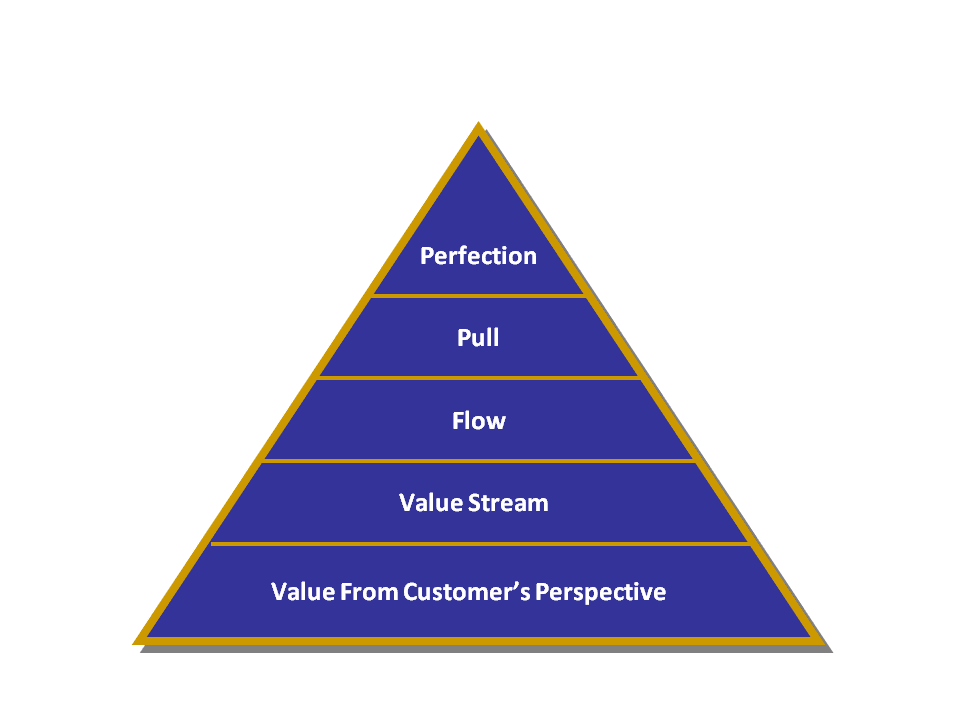
Lean Thinking - Identify the Value Stream


We are continuing our Lean Office transformation journey by seeing how we are currently adding value to our products.


Step 2. Identify all the steps in the value stream for each product family


Our team has spent some time talking to their customers about the important characteristics of the reports and analysis they provide and have talked to the boss about the performance levels required of the team.  Armed with this future state information the team is ready to move to the next step.

Starting the Lean Journey begins with knowing where we are right now and our knowing is based on can we really see what is going on.  Now is the time to break out your toolbox full of black permanent markers, canary yellow stickies, and tape some paper on the wall.  Step one is the most important, title and date your map.  Find your charter and tell the team the scope of the project as these will be the beginning and ending of the process flow.

Gather your team around the wall and arm them with the pens and stickies, and they will write the steps down that describes how the product flows through the process.  Make sure the steps on the stickies are written at the desktop level, not at the executive 50000ft.  This does a couple of things for us.  First the team has a sense of ownership of the flow, not just the map.  Second is the team, with internal customers and suppliers, have a true understanding of what is going on from step to step as the product is transformed from data into information.

The type of process map I have found most helpful is the swimlane map.  Imagine an Olympic style pool where each swimmer has their own lane.  This is exactly what your process map will look like, and each person, team, or function will have their own lane.  In these lanes you add the stickie notes in time order of how the product transforms.  Make sure you get all the hand-offs and rework loops.

Write down the cycle time for each step and the touch time, we will use this information to help calculate the total time and baseline process cost.  By now the team is loosened up, loaded with coffee, and has a common understanding of the flow.  Enter the Bad Cop...

It's time for Value Analysis.  Break out your Red, Yellow, and Green dots and ask the three questions (not from the old man from scene 24).  If we can answer "Yes" to all 3 at the same time, that stickie will get a Green dot.  They are; 1) Does the step change fit, form, or function of the product, AND 2) Is it a step that matters to the internal customer OR is it a step the customer would be willing to pay for, AND 3) Can we perform that step correctly the first time.  There is usually some amount of weeping and gnashing of teeth to get through the first two steps, but is faster the remaining steps.  No one wants to be thought of as "Non-Value-Added".

A step will receive a Red dot if any of the 3 questions are answered with "No" and there is no requirement, law, mandate, regulation, or rule forcing us to perform that step.  If there is something making us perform that step, then it receives a Yellow dot.  There may be other analysis you perform on the map, but this is the basic.

The map will be ugly, but it's yours to change.