Showing posts with label 5 Lean Transformation Steps. Show all posts

Tuesday, June 3, 2014

Lean Roadmap


Roadmaps are handy little things, helping to point the direction while on a journey.  Sometimes they serve to identify markers on the road letting us know how far along we are, or telling us how far to go to the next marker.  The Lean Roadmap provides some general direction to keep our focus forward.  Many times we will not get the results that we want when we pick our favorite concept to launch into first. The steps in this map build upon each other to reach the smooth flow of the moving or pulse line.  Just like most other efforts we start by talking to our customers and finding out what they like, don't like, and what's important (what is value?).  We can make some presumptions about our customers, but we should go talk with them and confirm our beliefs.


Create the Vision

We all know that being able to describe the vision simply or on paper is one of the most important first steps in communicating the vision, and being able to imagine the potential in your organization's operations can put you on the road to good change.  Creating the vision may or may not be aligned with your organization's offerings, and the most important question to answer is "how are we creating value for the customer"?

When we measure Product of the 4P's (People, Process, Product, Performance) we are taking a look at the product performance and customer demand.  The measure of performance should be based on the requirements or the capabilities the product is sold upon.  Customers have expectations about the Product for how it performs today and future enhancements.  Does the vision need the Product to be enhanced?  This is one part of the Vision.  We must also evaluate how our Processes operate, do our People have the skills and abilities for new Products and Processes, and is the Performance good enough to provide the customer the experience that will keep them coming back for more?

Standardize the Flow From Improvements

Once we know where we are going (Future Vision) we need to know where we are starting (Current State) and where is the first marker (Future State).  These are high-level maps and metrics describing the Vision and different States.  These will be used to target improvements in the flows: product flows, work flows, and cash flows.  

Target and reduce the waste and variation.  This is the mantra, this is the drumbeat.  Everything follows a rhythm and this moves the organization to the next level of performance.  Learn from your processes and make changes that can be documented in your SOP's, Policy Statements, and other Work Documentation.  Deploy the new learning across the organization and manage the change reaching higher levels of performance.  Using a Kaizen approach will be faster, and small steps will be required.

Make the Supplies and Information Point-Of-Use

Improving the flows is not only the transformation steps in process, but creating efficient movement of inputs to the process.  Make the material and information inputs easy to find and fast to move.  Ensure this is documented in the new process and that everyone is emotionally and physically on board with the new way.  Implementing 5S concepts in your operations are focused on organizing and not housekeeping.  Organize your material and information in files and on your servers/clients.

Balance the Team

As you make improvement stay aware of bottlenecks in the system.  Comparing cycle time to takt time will assist in determining where the help is needed first.  Continue this analysis as customer demand changes.  Bottlenecks can (and will) move through your system.


Implement Visual Controls and Response

Visual Controls are the metrics, schedule, and constraints posted on the wall or on the displays that the team needs to be aware of.  While we may have the vision that says "no more fire-fighting", there should be some recognition that quick action is sometimes needed.  Having the signals in place that facilitates this planned response is much better than waiting for the boss to find out from an unhappy customer.  This type of system is the foundation of an Employee Empowered Workforce.

Connect Suppliers Using Pull System

Implementing a Pull System is much more difficult and will create much frustration if you have not started improving your flow.  Responding only when the order is received (start signal) should keep cash flow high by not spending those dollars on material and labor that will only increase Work-In-Process (WIP).  High levels of WIP in your system is just half-built product sitting around waiting to be damaged or made obsolete.

Move/Pulse the Line

We can all envision a Moving Line with Lucy and Ethel inspecting and packaging chocolates.  A Pulse Line is one with products that move to the takt time and they have longer cycle times or the cost to automate the transfer is too high.  In the places where our office products are created, we can use electronic workflow queuing to move products and to status completion.  The "Line" is really a collection of interdependent work teams operating to accomplish a series of tasks.  The results are fed back into the Visual Controls and then analyzed for new learning.  Using this method will help us to move to higher and more stable levels of performance.


I hope this encourages you to take another look at Lean Flow and how you may use the tools and techniques to improvement customer satisfaction and employee relationships.


Monday, March 3, 2014

Lean Thinking - Make Value Flow Part 2

Making change is hard, but there are some models whose purpose it is to provide markers that shows the way.  These different road-maps take us to different destinations depending upon which journey we are on.  The criteria are specific, but easy to follow based on your current state.

PRODUCTIVITY IMPROVEMENT
Here we have our old friend DMAIC (Design-Measure-Analyze-Improve-Control) that is the umbrella for quality improvements based on statistical analysis tools developed in the '30s through the 1970s.  The model helps us to Define the problem, Measure how well the process is performing, Analyze for the root cause(s), Implement methods and practices to overcome the root cause(s), and finally Control our ability to backslide to the old and comfortable ways no matter how chaotic they are.

PROCESS DESIGN
If you are executing in the DMAIC model and one of the root causes is "we do not have a process", or you have been tasked to figure out how to do this new thing, then you may have found an opportunity to design a new process using DMADV (Design-Measure-Analyze-Design-Verify).  This should not be two dude's "Excellent Adventure" where you mess up until the boss finally accepts your new process because she is tired of your rock coloring game.  If y=f(x), then you need to figure out the important x's, or stated another way, stop guessing what color she wants for the rock.

Our Friend the Quality Function Deployment.  3 days?  Bah!


First find out who are the customers and what do they want about the product you are designing your process around, this is also called Voice of the Customer.  Do you have a large audience of customers?  Perhaps a well constructed survey would be best.  How about commandments from your company that your process must exist within or government regulations with which you must comply?  These would be the Voice of the Business.

Next, when you have collect this information, you can construct the Critical to Customer Requirements and Critical to Business Requirements.  Since "Critical" means measurable, we have the basis of performance.  No more needing to guess about the color of the rock she wants.

Now you can design the process that creates what is needed, how it is needed, in the amounts needed.  Simple right?  Probably not, especially if you think a complex solution proves just how intelligent you are.  Let's go with a solution that is as simple as it can be.  When designed and you have made a few rocks, do they align with the critical requirements?  If the answer no, then you are not finished.  Keep trying, you are almost there.  When the process is working as it should, document your process, someone will be expected to execute it later.

SOFTWARE DESIGN
The Software Development Life Cycle is a specific model used in the execution of software projects.  Keep in mind this is for implementing the solution that should be backed up with validated root cause analysis (remember the complexity thing earlier?).  The phases are Analyze, Design, Develop, Test, and Finalize; these should seem somewhat familiar in the DMADV model.

Agile is a customer-centered methodology where all the players are gathered together, complaints and good ideas are collected, prioritized, and executed in a group environment.  This is supposed to decrease the cycle time as everyone is together during the development and testing phases.  Scrum is a type of Agile where the prioritized activities are worked in Sprints using improved planning techniques.  This is an over-simplified explanation, but has shown to be effective when used appropriately.

WRAPPING IT UP
In the end we are trying to make our products flow better.  If we can design processes with less waste and variation, then achieving Return on Investment is faster.  Buy-in from our internal and external customers are important to our success in the future and our focus is still on the 4P's.

Monday, December 31, 2012

Lean Thinking - Respect For People

The foundation for Lean Transformation

Beginning the Journey and navigating this unknown (but common sense?) path requires a change in how Leaders and Managers relate with the employees.  This will be more than having a banner that states "Employees Are Our Most Important Assets!" in a 72 pt font or some kind of Employee Involvement committee that meets once a quarter whether they need to or not.  This is going to require you putting on your shoes and going to the place where the work happens.  And this should not be a one-time event, schedule the visits if you need to between your triple-booked meetings.

House of Lean with Respect for People as foundation
If this is your first time for your employees to see you on the floor, there may some staring and pointing, or some may even introduce themselves to you.  But I'm sure in this day of enlightened management techniques, you will not experience anything like this... right.  Employees will be open and honest if they are familiar with you and have some type of positive rapport.

You can also attend some of the team's meetings, listen to the comments they are making.  When was the last time you shared the company's strategy with them?  Do they make plans that align their Goals & Objectives with the direction of the company?  Do they understand how this Journey helps to improve the company's stability and long-term success?  Have you ever met anyone on the Board?  This Respect and Communication moves up and down the Leadership Chain.  Communication is not just Leadership making commands and the employees executing their wishes.

When we are developing and using our listening skills, we need to capture those comments that illustrate potential road-blocks to the implementation of the strategy.  These comments will need to be corroborated with your staff and seen in action.  The employees are looking for help when they need it, but we don't instantly implement suggestions just because they come from "the floor".  You will need to validate the problem's existence with measures.

We're not trying to make this a 12 month long six sigma project, sometimes the root causes are standing there and taunting us to make the first move.  Involve the Smart People in the measures, root cause identification and determining the solution.  The entire team owns the problem and the solution, this ownership will help facilitate the long-term solution that is followed and maintained.  Whatever the solution that is implemented, make certain that it is reflected in the standard work instructions.

When you have a measurable difference in the two methods, it's time celebrate success with the team.  Order some pizzas, make some certificates of appreciation, get them some gift cards, maybe it's time for a promotion, or some sort of positive reinforcement of the message that we are together on the Journey.  One instance of problem-solving does not make someone Lean, nor does it solve all the problems so someone "gets a belt".

If the problem is not validated, talk with the person who thinks it is there.  You may have missed something important, it may not align to the strategy, or there may be a deeper conversation to be had.  It is entirely possible that the Good Idea Fairy has been in the area having her way with unsuspecting employees.  Ideas have to be connected to a measured and validated problem statement.  If the decision is to not do anything about the problem yet, let the employees know why and when it may be addressed.

Improving is difficult enough, but having the team on board can make the Journey smoother.  Open and Honest communication can help make it happen.

Monday, July 2, 2012

Lean Thinking - Find the Next Opportunity

Reaching the fifth step of our Lean Office transformation journey doesn't mean we are done.  In many cases you will find that as customer satisfaction is increase, in performance and cost, demand should increase.


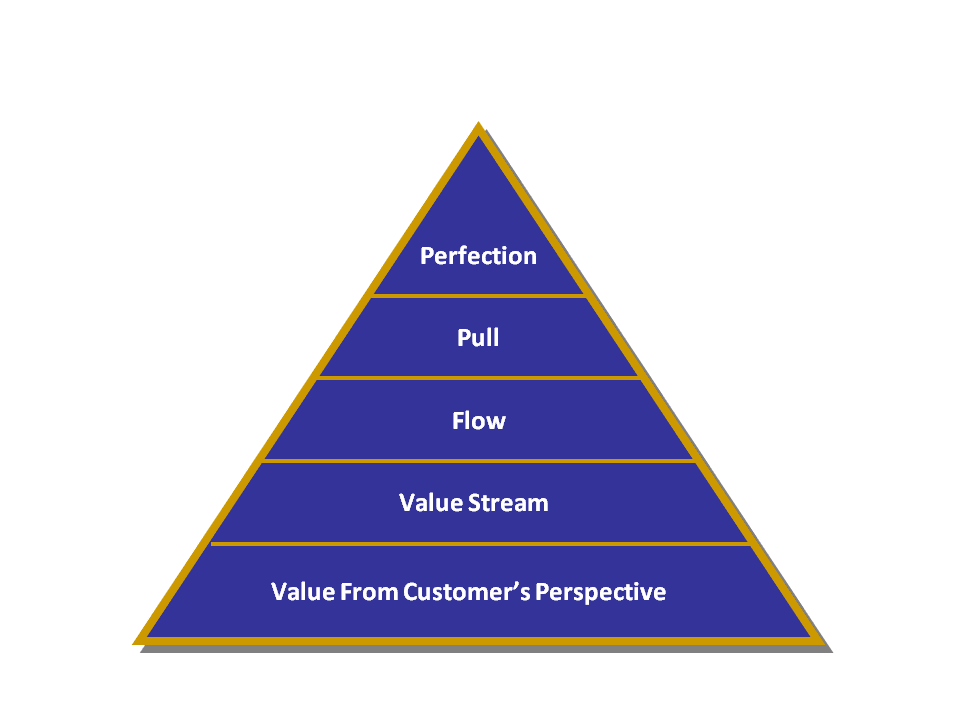
5. As value is specified, value streams are identified, wasted steps are removed, and flow and pull are introduced, begin the process again and continue it until a state of perfection is reached in which perfect value is created with no waste.


The teams that reside up and down the value stream have been working hard to improve the internal processes used, linking those improvements to what is important to our customers needs, improving the reliability from our suppliers, and removing the systems that are not working how we want.  It has been a busy couple of years, but we are stronger as an organization and sales are really picking up.

It's easy just to pull onto the next off-ramp, close your eyes and watch everything run perfectly, but this is not going to be the case.  Although you thought that you had successfully fired Murphy, he will show up again.  It may not be with this team or branch, but someone will pick up the Murphy flag.  These instances will test the system we developed; our visual controls, and our team's ability to find root causes and tweak the standard work. 

One popular tool is the After-Action-Review (AAR).  This is a method that can be completed in a short amount of time, usually less than an hour, compared to a 12 month Six Sigma project or a 6 week Kaizen event.  The AAR asks four questions; 1) What happened, 2) What was supposed to happen, 3) Why did it happen, and 4) What can we do in the future to keep it from happening again.  Using this technique teaches teams to become Learning Organizations, as opposed to only groups of individuals working interdependently on the same product and using the "Hope for Change" to get good results.

At the same time we go back to step one in the journey to decide what product needs help next.  While we are learning to see the interactions in the enterprise, opportunities will begin to fill the suggestion box.  This helps to further enhance the "Respect For People" aspect of transformational change.  I'm sure we have all seen the signs that say "People Are #1" and listening to them proves it.

During this journey you will find people who need to be in Leadership positions.  Those Leaders will need to be charged with the duty of developing the next generation of Leaders the ability to think about the long-term costs of inaction.  This is a skill that has been lost over the years that needs to be reclaimed and it is up to us to do that.  They are the teachers and mentors in the Learning Organization.

Question everything, why is performance bad or why is performance good?  Learn it, share it, and apply it.

Monday, June 25, 2012

Lean Thinking - Customer Pull Value

We are continuing into the fourth step of our Lean Office transformation journey by linking customer demand to our start signal.


4. As flow is introduced, let customers pull value from the next upstream activity.


Let's look where the Lean Journey has taken us so far. We have chosen one of the information products we create, map out how it flows, identified and eliminated the waste and variation in the flow, and now moving toward a predictable and repeatable process.  A method to help control quality, inventory costs, and throughput is to link input of work to customer demand, or a concept called one-piece flow.

One-piece flow is movement through the system, of the things we create, one at a time as opposed to moving in batches. Batch production is a concept from mass production where products move through the system with lots of friends. One-piece flow is cheaper because there is less Work-In-Process (WIP) in the system and WIP can represent the dollar value of labor and material used in the things we create.

This reduction in WIP also creates the ability for us to see problems in the flow.  Problems like to hide behind massive amounts of material, old processes that don't work, teams that feel trapped and have no hope, and metrics that don't tell us the real story.  Reduce the waste and variation and you will reduce the time from order to deliver.

Linking to customer demand requires a signal to start.  We don't create reports and analysis without that delivery being linked to a customer.  This signal may be on a visual management board, a work flow control system, or the boss drops a thick file on your desk.

Visual management is a method that helps us see what work is where, what is the priority, where are there problems, or if we're winning.  The concept of level loading can be applied here with the team and point to areas in the process flow that may need help.  While you are evaluating your condition, think about how extensive you are setup in little kingdoms or rice bowls and remember the examples of transportation and motion wastes.

The books "Learning to See" and "Seeing the Whole" are spot on with methods to think strategically about seeing flow and ability to see the representation of the relationship with us, our suppliers, and our customers.

Monday, June 11, 2012

Lean Thinking - Make Value Flow

We are continuing into the third step of our Lean Office transformation journey by finding the waste and variation in how we transform our products.


3. Make the value-creating steps occur in tight sequence so the product will flow smoothly toward the customer.


Our team has the process map on the wall showing how we currently create the product with Red, Yellow, and Green dots, Cycle Times, Touch Time, Inputs and Outputs, Rework Loops, and Handoffs.  As you stand back and look at this map you may ask yourself, "How do we get anything done around here with processes like that!".  And you would be right to ask that.... silently in your head, we are not pointing fingers here.

We now have some decisions to make, do we first attack the steps with the Red dots, or the high cycle times, or the rework loops?  This is a decision that could be based on the goals in the charter.  Fixing the quality of your work would be a good place to start to remove the Rework Loops.  Remember that the team is removing waste, not making the waste flow faster by high-speeding the product through a Rework cycle.  Again, we are not institutionalizing Rework.

This is the phase where we put our definition of Organization Optimization into practice.  How do we look at our relationships in the Value Stream.  Do we think our suppliers and contractors are greedy and are just out to steal our profits?  Or are they partners where open communication and shared problem solving is encouraged?  Do you have the same type of relationship with your customers?

Professional working relationships across our enterprise and overhead costs are also greatly enhanced by removing the other seven wastes.  This creates the ability to accurately predict performance and reduce the price point to increase demand.  As demand increases, so does our ability to meet it as removing waste increases capacity.

Another concept in our Lean Office is that of 5S.  This is not a housekeeping or cleaning methodology, but  a framework of standard practices that supports the organization.  This attempts to have us answer the following questions; 1) Do we need the things we have, and 2) Do we have the things we need, and 3) Can we see where flow is stopped, and 4) Are our teams performing at a consistently high level?  Think about the supplies kept in the copy room, the break room, at our desks, or even on our servers and computer desktops.

There are several improvement models that can be applied during this phase; PDCA, A3, 8-D, DMAIC, DMADV, AFSO21 8 Steps, and many more.  Ultimately these models contain tools to identify root causes, improve the results, and implement standard work to keep from backsliding.

As we move through the opportunities we will come across waste we have forced upon ourselves in our "ISO" type documentation or find waste linked to unfunded government regulations.  These are classified as Business Non-Value added activities and these are the steps on the process map with Yellow dots.  They are not impossible to remove, but it requires more work and a Leadership team that is fully engaged that is not afraid to show some courage.

Remember that Flow Is King, and a stop in the flow of what our customers desire from us is a stop in our ability to satisfy those desires.  Always involve the Smart People when we are eliminating waste.  One person typically will not have the solution, but each team member has a piece of the puzzle and all we have to do is snap the pieces together.

Monday, June 4, 2012

Lean Thinking - Identify the Value Stream


We are continuing our Lean Office transformation journey by seeing how we are currently adding value to our products.


Step 2. Identify all the steps in the value stream for each product family


Our team has spent some time talking to their customers about the important characteristics of the reports and analysis they provide and have talked to the boss about the performance levels required of the team.  Armed with this future state information the team is ready to move to the next step.

Starting the Lean Journey begins with knowing where we are right now and our knowing is based on can we really see what is going on.  Now is the time to break out your toolbox full of black permanent markers, canary yellow stickies, and tape some paper on the wall.  Step one is the most important, title and date your map.  Find your charter and tell the team the scope of the project as these will be the beginning and ending of the process flow.

Gather your team around the wall and arm them with the pens and stickies, and they will write the steps down that describes how the product flows through the process.  Make sure the steps on the stickies are written at the desktop level, not at the executive 50000ft.  This does a couple of things for us.  First the team has a sense of ownership of the flow, not just the map.  Second is the team, with internal customers and suppliers, have a true understanding of what is going on from step to step as the product is transformed from data into information.

The type of process map I have found most helpful is the swimlane map.  Imagine an Olympic style pool where each swimmer has their own lane.  This is exactly what your process map will look like, and each person, team, or function will have their own lane.  In these lanes you add the stickie notes in time order of how the product transforms.  Make sure you get all the hand-offs and rework loops.

Write down the cycle time for each step and the touch time, we will use this information to help calculate the total time and baseline process cost.  By now the team is loosened up, loaded with coffee, and has a common understanding of the flow.  Enter the Bad Cop...

It's time for Value Analysis.  Break out your Red, Yellow, and Green dots and ask the three questions (not from the old man from scene 24).  If we can answer "Yes" to all 3 at the same time, that stickie will get a Green dot.  They are; 1) Does the step change fit, form, or function of the product, AND 2) Is it a step that matters to the internal customer OR is it a step the customer would be willing to pay for, AND 3) Can we perform that step correctly the first time.  There is usually some amount of weeping and gnashing of teeth to get through the first two steps, but is faster the remaining steps.  No one wants to be thought of as "Non-Value-Added".

A step will receive a Red dot if any of the 3 questions are answered with "No" and there is no requirement, law, mandate, regulation, or rule forcing us to perform that step.  If there is something making us perform that step, then it receives a Yellow dot.  There may be other analysis you perform on the map, but this is the basic.

The map will be ugly, but it's yours to change.


Monday, May 28, 2012

Lean Thinking - Specify Value

The next few entries will share some examples of Lean Thinking in the Office and we will begin the journey with the first of five steps.  Begin Lean Office transformation with strategically aligning the opportunities.


Step 1. Specify value from the standpoint of the end customer by product family.


Beginning the Lean Office transformation is not a decision to be made flippantly and without a plan.  Does this mean you need to be in crisis mode or your platform needs to be on fire?  It's not required, but it does help to put energy behind and a reason for the change.  You may find that a new material is available on the market at a price that improves profitability, or Congress has written new industry regulations, or perhaps a company that you thought had no chance in being a real competitor has just had a successful launch of a new product or service.  What ever the reason, it is now in your lap.

To start this journey we first have to decide what product needs help the most.  Is it a series of financial reports, or briefings to provide information to decision makers, or how we procure office equipment?  One thing you cannot say is, "Lets go fix the sales team!!".  This is focused on the products we create, not people to berate.

Here we come to fix the Sales Team!!


The next step is to go have a conversation with your customer about the chosen product.  Now this should not be a scary trip to take.  When you schedule this discussion, frame it be asking some questions up front like "what about the delivery of my product needs to be perfect?".  Use this to collect attributes that would be critical to the quality of your product.

Another side of this method is asking what are the business needs of your operations.  Do you have to operate within a budget, or maintain a skills or knowledge requirement, or keep a safe work environment?  Think about the measures you are keeping now and are they helping you and your team find opportunities?  This is also a great chance to go talk to your boss about their expectations of your team since it is your job to make the boss look good.

The third piece of the puzzle is how the process is performing.  Are you having visions of SPC charts right now?  My friend's wife would yell out "NERD ALERT!!" at this point and we would all quickly look busy.  We should know what is going on, but the measures we take need to be used for good and not evil.  We never, ever take a chart and go beat up our supplier of data even if that was the standard practice in your industry.

This first step is very important as it sets the foundation for the rest of the things you will see and learn with this product and your team as it helps to create the vision of what the future looks like, but this is not a "one and done" activity.  As the market changes, you may need to do this with your customers on a regular basis.  It requires courage and tenacity, and don't be afraid to ask for help!  You may learn that you have some other Lean Thinkers on your team to help along the way and you will need their help when you move to the next step of transformation.