Showing posts with label Journey to Excellence. Show all posts

Monday, May 18, 2015

Information Supply Chain Excellence

We all see the effects of good and bad quality.  Whether we are in the hardware product flow or the information product flow, the level of quality of the inputs to our part of the process can impact how effectively we can perform our value-added tasks.  Occasionally we see glimpses of good quality inputs and can go straight to performing the work to change the product closer to what the customer is paying for.  Other times we have to rebuild everything to get what we need, thus delaying delivery and leaving the customer with a desire to find another supplier.  This "rebuild" requires labor and material beyond what is calculated in the base price.  The more "rebuild" you perform, the more your variable costs increase (hint, hint... the faster you will go out of business).

Looks like one person knows what I'm talking about....

Thursday, August 7, 2014

Quality and Acceptability of Solutions

In the past we have explored the difficulty of change.  One concept attributed to General Electric that we can wrap our heads around is Q x A = E.

Q = Quality Level (1-10) of the Solution to Solve the Problem
A = Acceptance Level (1-10) of the Solution in the Organization
E = Effectiveness (0-100) of Deployment of the Change

Friday, July 11, 2014

Transparency

Part Four of the Foundation Thinking Series

The word Transparency has received much attention over the last few years, yet I believe it is misunderstood among those who use it most.  Transparency implies openness, communication, and accountability. Transparency is operating in such a way that it is easy for everyone to see what actions are performed and how decisions are made.  We can see the results of actual Transparency in our Behaviors, Performance, and Values.


And since companies can't actually be accountable, communicate, be open, or exhibit other human behaviors we are really talking about the people in the company.  The people in the organization must have the right behaviors, performance, values, and integrity.  Problems around those issues will not be repaired if they stay in the dark bureaucracy where "people" barriers stop the flow of information.  If people in your organization have integrity problems, you will not like the results of you new-found imperative.

Wednesday, July 9, 2014

Accountability

Part Three of the Foundation Thinking Series

Accountability is the acknowledgment and assumption of responsibility for actions, products, decisions, and policies including the administration, governance, and implementation within the scope of the role or employment position and encompassing the obligation to report, explain and be answerable for resulting consequences. If you are accountable for the performance of the team, then when things go right it's you who will receive the benefit, but when things go wrong it's you who will receive the blame. When you are accountable you own it, not the last guy.

Monday, July 7, 2014

Leadership

Part Two of the Foundation Thinking Series

According to Ruggero & Haley, Leadership is influencing people by providing purpose, direction and motivation while operating to accomplish the goals and improving the organization.  This means that Leaders are Involved and Active in the Processes.

Let's break this down one piece at a time...

Monday, June 30, 2014

Process Discipline

Part One of the Foundation Thinking Series

In its original sense, Discipline is systematic instruction intended to train a person, sometimes literally called a disciple, in a craft, trade or other activity, or to follow a particular code of conduct or "order".  It also involved the practice of training people to obey rules or a code of behavior, using punishment to correct disobedience.  "And you will report status every day until it is fixed!"

Then there is Process Discipline and the "Rule of Rules”: Never make a rule that you are not willing to enforce every time. Every time equals consistency. In order to be consistent, therefore, the line between acceptable behavior and unacceptable behavior must be crystal clear. You must know exactly when to act.  Two ways we can cook discipline into our processes are by using standard work and by using a reaction plan in the process control tool.

Can it be any more clear than this??

Monday, June 9, 2014

Employee Buy-In to the Improvement Plan

As individuals we come up with really good ideas, changes to Products, Processes, and/or People in order to drive higher levels of Performance.  If we find a few people who think like us, the ideas and plans can become very elaborate.  We can hide in our offices or in the Innovation Stations and draw thought maps that would rival the great thinkers of Harvard and Yale.  But when we start implementing we fail to see the change we were looking for, our great ideas are stoned in the middle of the street, and we are ridiculed in front of our peers.

And that did not turn out how we thought it would.... once again.

Shaping the Vision

As we have explored before, change is hard.  It's harder when we don't include decision makers and smart people in the deployment of the vision.  The Captain of the ship points the way and we get to figure out how to get there.  "We" does not mean only the Directors and Senior Managers, it means all of us.  There are oodles of people out there, with skills and abilities that can help plan the change, execute the plan, transform the organization, and assess the results.

As the Captain's Executive Officer (XO), you get to figure out how to take the sometimes lofty statements by the boss and then translate them into what the future looks like for the organization and you are the point person for supporting the teams when the transformation begins.  More than likely you have something to start with, the Vision & Mission Statements, and the boss's lofty statements will typically track along in parallel.  Functionally this means something slightly different for each section of the organization based on how each connects to the main product or service that is provided.

The Correct Way To Draw An Org Chart

We have discussed creating the vision and specifying value in the past, but how do we take our thoughts and dreams on paper to those in the organization that will be going on this journey with us?  Spend some time talking with those teams to explore how they see themselves fitting into the Vision & Mission Statements and what do their metrics say about performance.  When they talk about the "things" they provide for the product or service, are they reflected on your VSM or Strategy Map?

Communicating the Vision

I'm going to presume that if you are in some sort (any sort) of Leadership position, that you have gotten over the fear of public speaking.  This will not be a one-time flash of the power point slide during an all-hands meeting and then you never speak of it again.  It will be discussed until everyone understands and are ready to start moving forward, and part of the conversation will be one where the vision is shaped.

You should discuss it everywhere you go.  Visit all the teams in their stand-up meetings, even if it's at 6am.  If you can put it on one piece of paper, hang the vision in the break rooms and the performance measurement screens on the walls.  Make it part of the company newsletters and create a video discussing the vision and how important it is to the organization.  When you are discussing it, do try to sound a little excited about the journey and the possibilities it will open for everyone.  And let the teams know they are part of this journey because they will be making adjustments to their 4P's also.

Share results with the organization while the transformation is ongoing.  What are the wins, what are the lessons learned, and what has been accomplished?  Reward some team members if you are having an all-hands meeting with the organization.  Instant awards like restaurant gift cards are cheap and easy.  Handwritten thank you notes provide a personal touch not seen today as often.  Award certifications if there are Green Belt or Black Belt certification projects tied to the change.

People want to know what you think about the transformation and if they are doing a good job.  Communication always comes up as a top issue for organizations and some of these ideas can help move you forward along your Lean Transformation.


Monday, May 19, 2014

When Good Ideas Go Bad

In my experience, groupthink is a behavior that can sink an improvement project if not caught and stopped early. Groupthink is where there is group pressure to ‘go along’ with the decisions of the group or the beliefs of the group. This can start with ill-defined problem statements, scope, and/or goals, and the team will stay on the wrong path if assumptions are not tested or questioned. Keeping charter information simple and validating the problem statement can go a long way control groupthink. Validation is accomplished through using process timelines or data that is reflective of the problem statement.

Another method to reduce groupthink is to use a balanced functionally diverse team. Members bring their own perspective of the problems and causes to the team and if functional diversity is not present, then the natural group will have the numbers to force their perspective on the other team members. Using balanced teams with one or two members from each function can prevent groupthink.


ummm, no.


My favorite cause of groupthink is when one "expert on everything" arrives and begins to tell everyone how to think. Many will go along to get along because they are afraid of making someone mad or they do not want to be seen as a non-team player or because they are introverts that are uncomfortable speaking up. As a project lead my first method is to take them off to the side and tell them to knock it off. If it continues I have called them out in front of the team, which usually sends them into the stratosphere. If I still do not see the behavior I am looking for I will send them back to their work group and let the boss know that I'm not interested in baby-sitting their problem child. I have not had to do this very often because we use ground-rules for team member behavior that are discussed during the kick-off of the project while everyone's Supervisor, the Project Champion and General Manager are in the room.

This type of behavior can show up at any time during the project whether it is executed through weekly team meetings or kaizen style locked in a room for a week. When the behavior arrives a the end of the week when everyone is tired and ready to go home, the aforementioned expert will begin to implement her solution. Another method to overcome is to provide everyone with a number of votes or rating system to use across different possible solutions. I have had good results with this style and will continue to use it in the future.


Ultimately setting the expectations for team behavior must be established early (and often). If you are on a team and you begin to recognize groupthink, it may be time to become the voice of dissension.

Monday, March 3, 2014

Lean Thinking - Make Value Flow Part 2

Making change is hard, but there are some models whose purpose it is to provide markers that shows the way.  These different road-maps take us to different destinations depending upon which journey we are on.  The criteria are specific, but easy to follow based on your current state.

PRODUCTIVITY IMPROVEMENT
Here we have our old friend DMAIC (Design-Measure-Analyze-Improve-Control) that is the umbrella for quality improvements based on statistical analysis tools developed in the '30s through the 1970s.  The model helps us to Define the problem, Measure how well the process is performing, Analyze for the root cause(s), Implement methods and practices to overcome the root cause(s), and finally Control our ability to backslide to the old and comfortable ways no matter how chaotic they are.

PROCESS DESIGN
If you are executing in the DMAIC model and one of the root causes is "we do not have a process", or you have been tasked to figure out how to do this new thing, then you may have found an opportunity to design a new process using DMADV (Design-Measure-Analyze-Design-Verify).  This should not be two dude's "Excellent Adventure" where you mess up until the boss finally accepts your new process because she is tired of your rock coloring game.  If y=f(x), then you need to figure out the important x's, or stated another way, stop guessing what color she wants for the rock.

Our Friend the Quality Function Deployment.  3 days?  Bah!


First find out who are the customers and what do they want about the product you are designing your process around, this is also called Voice of the Customer.  Do you have a large audience of customers?  Perhaps a well constructed survey would be best.  How about commandments from your company that your process must exist within or government regulations with which you must comply?  These would be the Voice of the Business.

Next, when you have collect this information, you can construct the Critical to Customer Requirements and Critical to Business Requirements.  Since "Critical" means measurable, we have the basis of performance.  No more needing to guess about the color of the rock she wants.

Now you can design the process that creates what is needed, how it is needed, in the amounts needed.  Simple right?  Probably not, especially if you think a complex solution proves just how intelligent you are.  Let's go with a solution that is as simple as it can be.  When designed and you have made a few rocks, do they align with the critical requirements?  If the answer no, then you are not finished.  Keep trying, you are almost there.  When the process is working as it should, document your process, someone will be expected to execute it later.

SOFTWARE DESIGN
The Software Development Life Cycle is a specific model used in the execution of software projects.  Keep in mind this is for implementing the solution that should be backed up with validated root cause analysis (remember the complexity thing earlier?).  The phases are Analyze, Design, Develop, Test, and Finalize; these should seem somewhat familiar in the DMADV model.

Agile is a customer-centered methodology where all the players are gathered together, complaints and good ideas are collected, prioritized, and executed in a group environment.  This is supposed to decrease the cycle time as everyone is together during the development and testing phases.  Scrum is a type of Agile where the prioritized activities are worked in Sprints using improved planning techniques.  This is an over-simplified explanation, but has shown to be effective when used appropriately.

WRAPPING IT UP
In the end we are trying to make our products flow better.  If we can design processes with less waste and variation, then achieving Return on Investment is faster.  Buy-in from our internal and external customers are important to our success in the future and our focus is still on the 4P's.

Monday, April 29, 2013

New Learning With Costs

I have been away from the Lean blogosphere this semester and focusing on AC 626 - Cost Accounting for Managerial Decision Making.  While I have done this type of work as an Industrial Engineer, I think this class tied together some loose ends that I was not aware that were swinging in the breeze.  While I will try to not geek out on you I think this has enhanced how I look at the impact that reducing cycle time has on your operations and eventually your customer, no matter what method you choose to use.


I think in this case Work-in-Process absorbs so much time and energy (that you have to pay someone to worry about) and the fact that our complex systems are not helping us reduce the cost of operations, we "enhance" the links between our employees and our systems with further complex processes.  This has a direct effect on unit cost and, if not managed correctly, will make us run our operations into the ground.  I think we have seen this with the automobile industry.  Why do we reward poor performance with bail-outs and loans that will never be repaid?

While I do not aspire to do Lean with all the cost improvements that we can eat, the focus is still cycle time and unit cost is a reflection on doing the right things right and making the right decisions.  In future writings I will address these with deeper detail.

In the mean time let you mind be aglow with whirling, transient nodes of thought careening through a cosmic vapor of invention!

Ditto.

Monday, March 25, 2013

Managing By Means

Here is a beautiful song destined for Top 10 eternity by Doug Hendren, Managing By Means.  This is a lovely song based on the Toyota Kata.


Monday, February 4, 2013

Lean Transformation: Top Down or Bottom Up?

When we have Command & Control and grass roots effort, what do we do with the frozen middle?

I have talked quite a bit about the roles of Leadership, Facilitators, and Team Members.  These are important people that are Setting the Vision & Direction, Leading Teams to Improve Processes, and Providing Expertise in their Job Functions.  But what do we do with the managers between the top and bottom of the organization?  These people are the hard-chargers who were good fire-fighters that were needed at the time based on how we performed work under the batch and queue system of production.

These people now own processes, are measured to achieve results (maybe?), and are supposed to be growing the next generation of Leaders that will be replacing them in the next few years.  If you want the improvements to stick, they have to be involved in the change.  This level of the organization is where most of the Project Sponsors will reside.  Increasing the flow in their processes will improve their measures and provide them the opportunity to think beyond the fire of the moment.  Once you are on the Journey there will be less need to break out the old fire-fighting helmet.

This is where strategic tools like Lean Policy Deployment, Value Stream Mapping, and PICK Charts come into play.  These prioritization decisions are owned and controlled by the Process Owners.  It's not as exciting as putting on the Cape and Cowl, but it creates the condition where stability and balance can flourish.  Overcoming the daily fire drills can positively contribute to reduced levels of stress and decreased burn-out.  Remember what Dr. Tyrell said, "The light that burns twice as bright burns for half as long."

Once it is determined which improvement is first and what resources will support the transformation the Project Sponsor will help to draft a charter with the Facilitator.  The charter provides the reason the team exists as it defines the Problem Statement, Goal, Scope (In and Out), Business Case, Resources, and Milestone Review Schedule.  If you are trying to use Lean Six Sigma to implement your "good ideas", you will be very disappointed.  The Good Idea Fairy is the ultimate business trickster and will lead you to the point where you are completely disappointed and will resist anything that remotely sounds like Lean and/or Six Sigma.

Our transformation model is simple enough to understand, but is not for the weak-willed.  You must have stamina to make it through the steps, and you will find that you spend a good portion of your time "Making Value Flow".  But this is exactly where you involve your Facilitators and Smart People to make the good change happen.  On the other side you will have a stronger and smarter team.

Monday, January 14, 2013

We're All Leaned Out!

This has to be my favorite sayings from managers.  It speaks volumes to a team's current state on the Journey to Excellence.  These managers are not in every company, but this is what they seem to know to say.  And in their minds they are correct because no one has shown them what right looks like.

I think the interaction between the Point Haired Boss and the Six Sigma Consultant was clear.  "First identify the problem", in which the PHB responds with "we don't have any problems, what's next?"  Not only is he a liar, he is delusional.  Give it a few years and he will be on an episode of Corporate Hoarders.

The way off this path requires Vision and Leadership.  You have to be tired of the constant review failures, status meetings, part shortage meetings, network downtime, "special" visits to the boss's office, or the worst indicator - constant fire fighting.  You have to say NO MORE!!  And you have to dig out.  You may find that you have the wrong people on the your bus (thanks Jim!).

During the teaching and mentoring the use of Lean Thinking we focus on what we can see.  In the information flow we have to look at cycle times, review (quality) failures, or other flow stoppers.  This is the purpose of the visual management boards.  And keep your charts current and relevant.  Don't forget to talk to your customers about the products or services you provide.

Document your results on an A3 and look across the organization for similar issues where you can apply your new learning.  Celebrate the team's success and always be learning.


Monday, December 17, 2012

When Is Enough, Enough?

A Long Time Ago In A Galaxy Far, Far Away...   

I was teaching the Statistical Process Control & Capability module during a Lean six sigma Green Belt class and one of the students asked, and I'm going to paraphrase, "When is enough, enough?"  I think this would be a normal question to ask while learning how to Make Value Flow.  The question came from one of my Quality friends, and I'm sure he was thinking about all the different processes he supported that needed improvement and certainly not when he could put his feet in the air and his "you-know-what" in the chair.

If you have been measuring your performance, then you should have some amount of data collected around the problem you are experiencing.  If you are having quality problems, you may have Defects Per Unit (DPU), or Defects Per Million Opportunities (DPMO).  If you are having delivery problems, you may have Cycle Time or Number of Days Early/Late.  If you are having cost problems, you may have Cost Per Unit or Weekly Printing Costs.  Either way, you need some data that represents your process.


We can see the performance is in control and the stable, but is the process meeting the customer's needs?  This is always the right question!

When we use SPC we are looking for  indicators that signify when to start asking questions about the process.  There are four that are the easiest to use and remember; 1) Any points outside of the control limits, 2) Six points consecutively going up or down, 3) Nine point consecutively above or below the center, and 4) 14 points consecutively going up and down.  Having a process that performs within these four parameters means that our process is in control and stable, which indicates the flow is predictable.

Here is your SPC warning!  Do not let any of you Quality Engineers catch you putting specification lines on your SPC chart.

What it does not tell us is are we meeting customer expectations.  This is where we take our Voice of the Customer specifications and lay them on top of a histogram of the data.  From here we can see our performance compared to customer specs of no more than 21 days (USL, LSL).

Current State

And as we can see from the fine specimen above, when our cycle times are 22-25 days we are not meeting customer expectations.  Our process is in control, but not performing to the wants and desires of the customer.  In fact it may be possible that our favorite customer is looking for a new supplier of their information needs as we speak and I think that immediate action is required.

At this point you should be constructing a charter, assigning one of your belts to lead the project, and kick-off the team.  Work your best as a Project Sponsor, Smart Person or Supplier/Customer and document the results in an A3.  When you have enough data with the new process you can see how the center and spread fit within the specifications.

If you have identified the root causes and adequately implemented a new process that has improved flow, then you are done with that process for now.  The biggest indicator is the edge of the distribution is some amount away from the specification.  For you math nerds, below is the formula and you want to get as close to 1.5 as you can.


Improved Process #1

Based on our results we can see that are delivering everything on time, and if we finish early we can hold the deliverable until the customer is ready.  Be wary of producing too much too fast.  That would make our work-in-process increase, which means the window between "doing work" and "getting paid" increases and this is detrimental to cash flow.

At the end of the day we want our products to flow without stopping though our value-added operations to meet customer demand.  Deliver too late and the customer must wait (Wait Time), but if we deliver too early the customer has to over-handle (Excess Processing) the product until they are ready to use it and this is "Inventory" they have to hold until they are paid.  If you have paid any attention over the last 5 years, this over-capitalization is one of the causes of the downfall of the American automobile industry.  Leadership is the decision-maker, but the following histogram represents one possible best fit.

Improved Process #2
Improving performance is not something that will automatically happen, learning curves are not absolute.  Market forces fluctuate and your ability to adjust with them could be one of your long-term indicators of success.

How do you use your data for improving flow?

Monday, October 22, 2012

Book Review: The Integrated Enterprise Excellence System


Forrest W. Breyfogle III, the author of "The Integrated Enterprise Excellence System", has written about a system of strategic tools and methods to see the alignment and performance of organizations.  His book lays out the different methods of metrics, management governance, goals, and strategic development.  He connects these and other concepts using an Enterprise DMAIC model.


In my opinion this book was written for Leaders and Managers of organizations, people who's work is at the system level of the organization.  These could be team leaders, supervisors, managers, and executives.

Mr. Breyfogle has been a proponent of the "wise use" of statistical techniques and this book does a great job of connecting those dots to transforming organizations into customer satisfying machines.  I recommend this book to all my readers.

Monday, October 1, 2012

Teaching With Simulations

One of the joys of being the Lean Guy in the office is I get to share my knowledge and experience with other people writing contract documentation, purchasing orders, engineering changes, software code, system specs, and all the other pieces of information floating around the office.  When we talk about Lean and the thing they are working on it is helpful to show an example of what right looks like.  This is helpful because their product is special, and no one else processes it like they do.  Special....right.

We will presume that I am not dealing with a TQM victim that is feeling frisky that day.

A tool that I keep handy is the paper flow simulation.  We use index cards as the "document", technical reviewers, value-adders transforming the document, and some metrics for quality, cycle time, and throughput.  This sim is cheap, easy, portable, gets the point across, and I'm not going to give away the ending, but all the team win.

Another great teaching aid is the 5S Numbers Game.  I'm not sure who developed this, but it is my favorite for teaching 5S in the information flow.  This link will take you to Lean Simulations' 5S Numbers Game page where you can download it and try it out for yourself.

My Favorite Sim in the Office!
There are other longer Lean System simulations, The Beer Game at The Lean Learning Center, and a  simulation used by the U.S. Military called FedSim.  These teach supply chain control, aligning tasks with requirements, and passing products through the enterprise.

Videos are great too!  Terry Tate, The Bridge of Death with the Old Man from Scene 24, Dinosaur Office, Building Planes in the Air, and others help to lighten the mood and show how far into the extreme a process could go.


When thinking about sims and videos, make sure the topic fits the organization.  Factory sims, stories, or videos will not work in the office.  First reason is because few of the people you are talking to have ever seen a factory, much less stepped in one.  Second is because factories are loaded with assets; equipment, inventory, tools, things being transformed into a product being sold to someone.  And our processes have computers, printers, fax machines that no one uses anymore, binders, paper cutters, IT Helpdesks; yeah, we're special.

What kind of sims do you use in the office flow?

Monday, August 27, 2012

Lean Flow and Employee Involvement


There is no shortcut or back road to Lean transformation, it's not a journey you make on your own change, and it's not a top-down only effort.  But you have some busy people that can help you navigate in the dark, they are your employees.  How many of us remember when work arguments were won based on volume and creative profanity instead of the facts and data of the situation? The yelling may have diminished, but I'm not sure we are all in for using facts and data.

We do know that it is rough out there, but this is not the time to hide in the office and wait for the dust to settle.  Now is the time to look at how we do things to better meet customer needs and expectations.  We know that Lean is based on the Toyota Production System and part of the foundation is "Respect for People".  Everywhere I have worked, Leadership says that "People are our most important asset".  Does anyone know what that really means?

Lean Transformation Model
As you notice from the model we start with choosing one of our products and ask the team what they think their customers would say about that product.  We need to go talk with the customer also, but this gives us a starting point.  Share this information with the team, it may shock or surprise them (or confirm what they know) but the truth will be there out in the open.  Think about how these truths align with the 4P's.

When we map and measure the processes that support a product we are using the team not only to uncover the hidden processes we use, but so we all have a common understanding how we construct that product.  There will be human interactions the team may not have experienced before and you need to be ready to lead them through the various situations.  Make sure you attempt to includes everyone's voice.  Even your hard working introverts that are not sitting at the table (there they are along the wall) have something to say.

If you have adequately defined the flow problem and identified the most likely direct root causes, ask your team members for their suggestions to overcome the causes.  Some of the team may have been through that type of problem and could have the answer.  Try the solutions before any wide-scale implementation to uncover any constraints you may not have anticipated.  One person on the team, or the boss, will not have all of the answer that is needed, but each person may have a piece of the answer and it is up to you to create the picture of the new process.

Once you have the solution implemented, track the performance and share the results with the team.  This should be displayed on a board in a common area and where you hold team meetings.  You may even be able to connect that information with customer surveys or financial analysis.  Share the before and after data with the team to show them their efforts are making a difference.

What has been your experience working with teams or being on a team that improved one of your processes?

Monday, August 6, 2012

Poke-Yoke the Engineers

Being an engineer and forced into a box did not "feel" right.  How am I supposed to use my technical creativity to take these requirements and turn them into something you can hold in your hand?  Get away from me with your process stuff, I'm here to (hold up your shield) support the customer!!

I acted this way for a time while adjusting from being a recent college graduate to a responsible and productive member of society.  I had my office, with three computers, bookshelves full of component specs and design books, and my attitude of "THESE HANDS WERE TOUCHED BY GOD!!".  Obviously those people don't understand my brilliance and I must dumb-down my methods to meet their level of intelligence.  Now, if I could automate the human out of the equation quality and productivity would instantly improve.

Wow!! Was I really that full of myself?  I don't think I was very helpful during that time in my career.  I had just left Uncle Sam's Misguided Children two years before and graduated with my Manufacturing Engineering degree a few months prior. I had a few career successes and my level of confidence in my abilities were over-the-top.  I had lost my touch with reality and the work relationships suffered.

It only took a project or two to learn that my work produced a product that was needed for another team on the floor and their success (read as OUR success) was based on how well I performed, not just technically but to their schedule. I learned there was enough variation in my output to disrupt everything on the floor when I worked in my own smoke-stake or rice bowl.

We started by paying attention to the feedback coming from the floor.  How often were they coming back for us to fix something, how much time was spent during changeover, and how often did we deliver our products late to their need?  Simple, but powerful measures to gauge performance.  When we analyzed the data coming from the floor, we found the enemy and he was us.

Continuous Learning Cycle
Our first move was to document changes being made on the fly and changes being made at our desks.  Most of the changes had been made on the floor, which hid most of the problems and the information showed us how bad our product was.  A picture began to form showing what exactly who the culprits were and they were quickly standardized through our purchasing department.

Next we checked all our computers to ensure we were all connected to the right data sources.  Some had "drifted" off course and was quickly realigned to master libraries.  We saw a vast quality improvement after the last of the "bad" product had gone through the system.  It looked like the worst was behind us, but in reality we were still in a fragile state.  We still needed to update our standard desk guides.

When we stabilized our output, we began to chance variation in the inputs.  The design engineers had their design software connected to standard data sources linked to our MRP system.  We tracked our requests to them to fix their problems, shared that data in a professional manner, and saw results.  We found problems in the MRP system also and many times the reason was they did not think that option mattered to anyone.

It is great to feel like the hero that saves the day, but after a while we get tired of the same old problems.  It looks like no one cares when things do not improve on their own.  We live in the information age, and when there are problems with the information flow we have to address those to closure.

What has been your experience working in the data flow?  Have you seen improvements over the last few years?

Monday, July 9, 2012

What Are the Right Measures to Use In the Office

It's Friday afternoon and it's quiet, almost too quiet.  Your phone rings and it's the boss telling you to come to her office, now.

What is it now?  I'm almost done with my TPS report and I have big plans this weekend!

You find your pen and something to write on, and head to her office.  It's like this every last Friday of the month, a panic discussion about the end of the month metrics.

We're overrunning our IT and overhead budgets, what sales orders can be closed before the end of the month, and which suppliers we put off paying for another 30 days?

It's the same panic-attack every month, and the last branch chief was worse.  We should be able to predict these things instead of going through all this drama.  Some way of looking each week to see how we are doing. But we don't work on a manufacturing floor, we push paper around the office, we are completely different.

Wow, I think we have seen this situation play out more than once.  The key here is not only figuring out how to avoid the panic attack, but to be able to predict how the month will end with plenty of time to respond.  This journey certain starts with recognizing who the customer is and what do they want.  If the thing we are working on goes to a customer whether inside or outside, we will use the Voice of the Customer (VOC) to develop our metrics.  If there are corporate or team objectives we reaching for, we will use Voice of the Business (VOB) to develop the metrics.

The VOC conversation starts with something like "what are the things about my product that need to be perfect?".  The "things" may focus on delivery, quality, cost, performance characteristics, or any other "thing" that may be on the customer's mind at that moment.  You will need to guide the conversation based on some feedback you may have or you will spend weeks in the weeds chasing rabbits. These conversations will help improve the relationships with your paying customers and provide a creative outlet for the team to work toward instead of the day-by-day painting of rocks trying to find the color the customer wants.

The VOB conversation is based on those corporate objectives that come down at the beginning of the year, newly created government regulations, or corporate governance policies.  The boss is giving you signals that you probably should not ignore and some exploration of details of how to execute policies can provide insight on how to measure the execution.

Take this information back to the team and explore their input on what those measures are and how that data is collected.  Do you have systems that you work within that collect time and date stamps, who is contributing to or approving steps in the work flow, track travel budget or sales totals?  These may be sources of data needed to create the metrics that can show if the team is on track or not.  It may take a little time to create a baseline, but you will soon be on your way to avert being blind-sided.

When you have the metrics created, don't just hide them on the corporate share-point servers.  Share them with the team, talk about the performance and maybe some root causes if the performance is not where it should be.  Teach the team how to talk about performance improvement and don't use a bunch of Japanese or Six Sigma words to show everyone how enlightened you are.  This is not a finger-pointing session.


In the mid-90's I worked for a telecommunication company in prototype manufacturing, building typical quantities from 1 to 10 with the median quantity being 2 or 3.  Our model was Low Volume/High Mix and we were in the change-over business.  The boss kicked-off one of our weekly staff meetings with the question, "Where is the waste in our processes?".  This was an odd question, and instead of someone asking what he meant by "waste", the two main factions began to attack each other.  The meeting did not end well, but it did start me thinking about how we transform information and material into circuit boards.

We had business goals (VOB), build prototype work orders in 3 days and pilot production work orders in 7 days.  This was easy to think about in manufacturing, but I was leading the machine programmers, we were creating software programs and reports.  In reality we had about 2 hours to complete our work that fed into the next steps of the process that eventually provided engineering with test results to a final customer that was buying our stuff.

Ultimately we had to show that we were helping to improve our processes and we did this through the use of metrics over time.  Metrics that were reviewed on a weekly basis with the actual team doing the actual work.  When we were aware of a problem, we would convene on that problem, talk about root causes, determine what to do about it, and update the deskguide we used for how we performed the work.  And all this was tracked in our metrics based on the reports we were producing.

As you begin looking at what you do and what metrics are relevant, what you finally decide to use may be very different compared to what you started with.  This is part of the journey, finding the right roads to take you where you are going.  And if you want something quick and dirty to start with, three popular measures are On-time Delivery, Percent Complete Delivered, and Quality Yield. Remain positive with the team, some emotions will rise up and remind everyone that we are in this together.

Monday, June 25, 2012

Lean Thinking - Customer Pull Value

We are continuing into the fourth step of our Lean Office transformation journey by linking customer demand to our start signal.


4. As flow is introduced, let customers pull value from the next upstream activity.


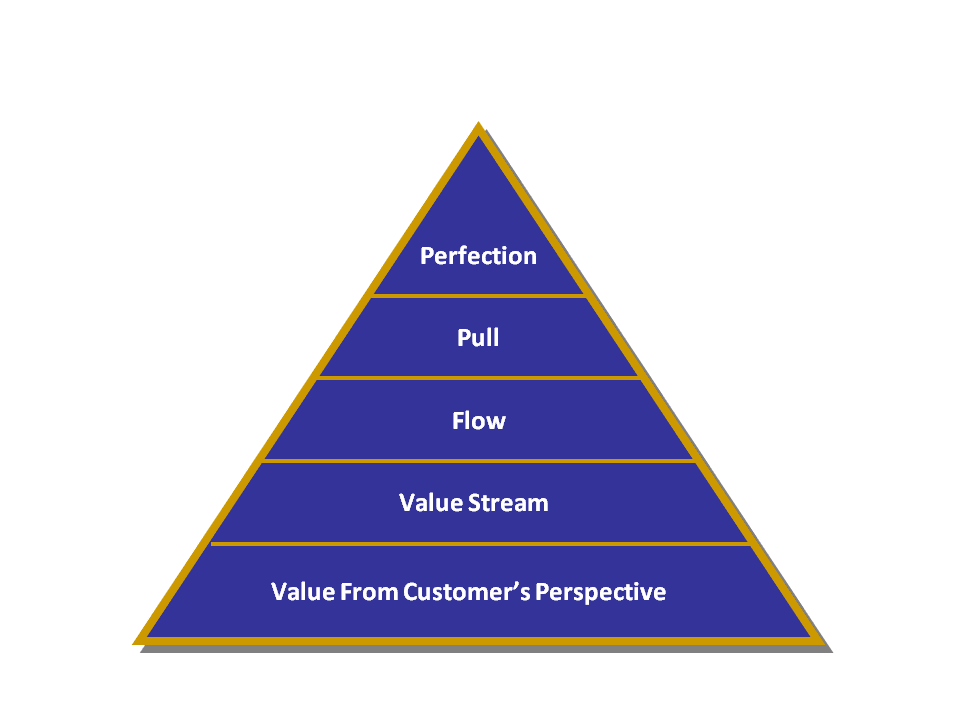
Let's look where the Lean Journey has taken us so far. We have chosen one of the information products we create, map out how it flows, identified and eliminated the waste and variation in the flow, and now moving toward a predictable and repeatable process.  A method to help control quality, inventory costs, and throughput is to link input of work to customer demand, or a concept called one-piece flow.

One-piece flow is movement through the system, of the things we create, one at a time as opposed to moving in batches. Batch production is a concept from mass production where products move through the system with lots of friends. One-piece flow is cheaper because there is less Work-In-Process (WIP) in the system and WIP can represent the dollar value of labor and material used in the things we create.

This reduction in WIP also creates the ability for us to see problems in the flow.  Problems like to hide behind massive amounts of material, old processes that don't work, teams that feel trapped and have no hope, and metrics that don't tell us the real story.  Reduce the waste and variation and you will reduce the time from order to deliver.

Linking to customer demand requires a signal to start.  We don't create reports and analysis without that delivery being linked to a customer.  This signal may be on a visual management board, a work flow control system, or the boss drops a thick file on your desk.

Visual management is a method that helps us see what work is where, what is the priority, where are there problems, or if we're winning.  The concept of level loading can be applied here with the team and point to areas in the process flow that may need help.  While you are evaluating your condition, think about how extensive you are setup in little kingdoms or rice bowls and remember the examples of transportation and motion wastes.

The books "Learning to See" and "Seeing the Whole" are spot on with methods to think strategically about seeing flow and ability to see the representation of the relationship with us, our suppliers, and our customers.