Showing posts with label Continuing the Journey. Show all posts

Monday, April 28, 2014

Idea Transformation

How to make an "idea" person into an "implementation" person?

Sometimes you are minding your own business watching the clouds float by, working on another marketing presentation, or on a date with that special person in your life, and then POW!!!  You are hit so hard that it gives you a shiner on your driver's license.  The Idea Fairy has shown up to occupy the brain space you were using to focus on what was in front of you.  If you know whats good for you, you will write the idea on a napkin so you can put your focus back where it belongs.  Even better if you have a bright idea notepad (handy-dandy notebook?) that you carry around.

"Life's tough when you're stupid"

If you have spent some time observing your behavior, you may have determined during the day when you are at your most creative state and when you are at your most productive state.  I am an early morning thinker and a rest of the day doer with a brief blast of creativity late in the day.  Find your thinking time and space and pull out the idea assault from the day before and think about what you want to accomplish.  This is a dreaming phase to help you characterize the idea; write as much as you can about the end state.

What does your idea look like??

WARNING!!  The next step is where our excited idea holders begin to fall off the rails on the way to Awesome Town.  As boring as this sounds, you need to plan the implementation of your great idea.  
  • What stuff (material or data) do you need to start with
  • What kind of people help do you need
  • What do you need to learn
  • Do you need some money to make the idea happen
  • How are you going to market the idea
  • How much time do you need (or can you take) to implement this great idea.  
Keep in mind that some ideas have a short time span when the market is right and there is alignment between your great idea's purpose and the need it is meant to serve.  The project plan is to lay out our path and assist in determining if an important task needs to be accomplished before another.

If you are in the middle of a kaizen event and someone is hit in the head by the Idea Fairy, you can use a simple form to capture the idea that can help with implementation like the one below.  She will show up at the most inopportune of times demanding respect and acknowledgement.  Capture the idea, stick it to the process map or fishbone diagram and move along until you are ready to evaluate the idea.

There is DOWNTIME from the 8-Wastes!!

During implementation of the great idea, stop and look at the plan for changes that may need to be made and talk with your team members or mentor about the progression.  Is it coming together like you dreamed about days or weeks ago?  If you suffer from Not-Invented-Here (NIH) Syndrome, I recommend that you get over yourself.  No, I'm not kidding.

While this is an over-simplified version of what project managers do, it will take some practice before you are doing it right.  Remember that each failure is a stepping stone to success.  Don't give up, and learn as you move through your Journey.

Also remember that great ideas can come from little brothers.  Thanks Jeremy!


Monday, March 25, 2013

Managing By Means

Here is a beautiful song destined for Top 10 eternity by Doug Hendren, Managing By Means.  This is a lovely song based on the Toyota Kata.


Monday, July 16, 2012

Just-In-Time for What?

What JIT is and what JIT is not...

Just-In-Time, three little words that strike fear in the hearts of American manufacturing.  Site Leaders, Production Control & Logistics Managers, Team Leads, Purchasing Directors, and the list goes on of people who thought JIT meant that we could close our warehouses and just order parts we need when we need them and not have to worry about anything else.

Sorry, but that is just not right.  We have seen the results; late parts that causes the lines to stop, creates new positions in the company called expeditors, generation of new reports on shortages with special color codes and plenty of columns of useless information.  People get fed up with this thinking and go rogue.  We "find" parts outside of the supply chain, usually in someone's "safety stock" in their desk.  But that will not sustain the system for long.


Now that the rant is over let's talk about what JIT really is.  Using Just-In-Time thinking requires alignment of all activities on the "thing" going through the process to the final (paying) customer.  JIT is a future state of thinking, a result of implementing the 5 steps of Lean Transformation.  Remember, Lean is not a program, but how we run the business.

As waste and variation are removed, you are left with a stable and predictable flow where the work can be loaded equally through the different value-added teams.  This gives you the chance to measure the material required to produce your product.  How much paper do you go through in a month?  What is the cost of office supplies?  How often do you need to archive data to keep your servers available?  Are your teams spread out randomly, only where you could find space, or are they strategically located near the customers?  What is the $$ value of your work in process?

Yes, those are a lot of questions!  Important questions, and you should be asking more, even snotty questions.  And don't forget to ask the team if there are any roadblocks that need to be knocked down.  The intent is to guide the improvement teams to think outside of their "safe" places.

But we are not harassing the team to implement your idea of how the process is supposed to operate in your head, but enable the teams to succeed.  These questions may push the team to create break-through process redesign.  In the end we are looking for processes that operate to customer needs at the lowest possible cost.

As your internal operations begin flowing predictably, it's time to look at your suppliers.  Do they really provide the items you need, when you need it, at the amount your need it, and the right quality?  More questions?  Yes!

Time to reliably replenish is the metric for suppliers.  It captures quality, on-time delivery, and order delivery levels.  Use this information to know if you need to work supplier development opportunities as they should pay off in the long-term.  And make sure you include your engineers, supply chain pros, and quality.

JIT is a great result to achieve.  Lower WIP costs (WIP = Labor + Material), and lower overhead because we are holding the right amount of stuff we need in stores to support our activities.  Don't just think of it as a factory target, but as one that pays back to the bottom line and increases shareholder value.

Monday, July 2, 2012

Lean Thinking - Find the Next Opportunity

Reaching the fifth step of our Lean Office transformation journey doesn't mean we are done.  In many cases you will find that as customer satisfaction is increase, in performance and cost, demand should increase.


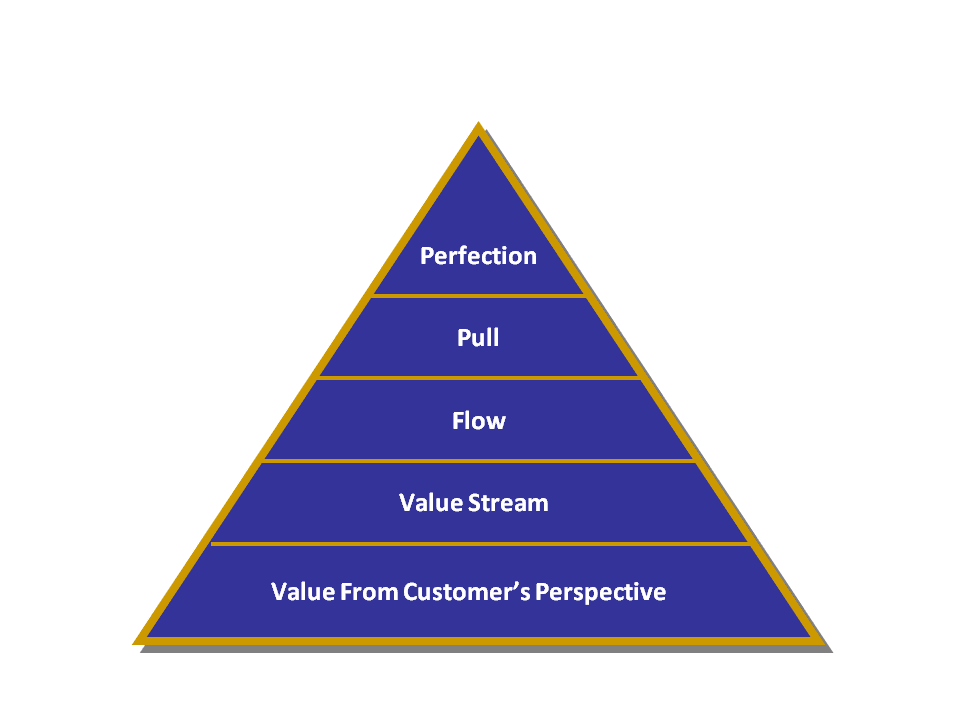
5. As value is specified, value streams are identified, wasted steps are removed, and flow and pull are introduced, begin the process again and continue it until a state of perfection is reached in which perfect value is created with no waste.


The teams that reside up and down the value stream have been working hard to improve the internal processes used, linking those improvements to what is important to our customers needs, improving the reliability from our suppliers, and removing the systems that are not working how we want.  It has been a busy couple of years, but we are stronger as an organization and sales are really picking up.

It's easy just to pull onto the next off-ramp, close your eyes and watch everything run perfectly, but this is not going to be the case.  Although you thought that you had successfully fired Murphy, he will show up again.  It may not be with this team or branch, but someone will pick up the Murphy flag.  These instances will test the system we developed; our visual controls, and our team's ability to find root causes and tweak the standard work. 

One popular tool is the After-Action-Review (AAR).  This is a method that can be completed in a short amount of time, usually less than an hour, compared to a 12 month Six Sigma project or a 6 week Kaizen event.  The AAR asks four questions; 1) What happened, 2) What was supposed to happen, 3) Why did it happen, and 4) What can we do in the future to keep it from happening again.  Using this technique teaches teams to become Learning Organizations, as opposed to only groups of individuals working interdependently on the same product and using the "Hope for Change" to get good results.

At the same time we go back to step one in the journey to decide what product needs help next.  While we are learning to see the interactions in the enterprise, opportunities will begin to fill the suggestion box.  This helps to further enhance the "Respect For People" aspect of transformational change.  I'm sure we have all seen the signs that say "People Are #1" and listening to them proves it.

During this journey you will find people who need to be in Leadership positions.  Those Leaders will need to be charged with the duty of developing the next generation of Leaders the ability to think about the long-term costs of inaction.  This is a skill that has been lost over the years that needs to be reclaimed and it is up to us to do that.  They are the teachers and mentors in the Learning Organization.

Question everything, why is performance bad or why is performance good?  Learn it, share it, and apply it.